
Natural Lapis Lazuli Beads for Sale: Buying Guide
Table of Contents
Why Choose Natural Lapis Lazuli Beads for Your Jewelry
Quick Comparison: Top Sources for Natural Lapis Lazuli Beads
Understanding Lapis Lazuli Grades, Colors, and Shapes
How to Identify Real Lapis Lazuli: A Step-by-Step Guide
Selecting the Best Gemstone Beads for Jewelry Making
Lapis Lazuli Jewelry Design Ideas for Your Next Project
Where to Buy Natural Lapis Lazuli Beads and What to Pay
Final Thoughts on Buying Lapis Lazuli Beads
Frequently Asked Questions
Last Updated: September 6, 2026
Natural lapis lazuli beads for sale are everywhere online, but finding genuine stone that matches its photos is another story. The market is flooded with dyed howlite, reconstituted material, and treated imitations that look right at first glance but lose their color or luster within months. This guide breaks down exactly what separates authentic lapis from the fakes, how to grade quality by color and cut, and where to source strands that hold up in professional jewelry making.
Lapis lazuli is a metamorphic rock prized for its deep royal blue color, flecked with golden pyrite and sometimes white calcite. Value depends on the intensity of the blue, the proportion of pyrite to calcite, and the consistency of bead shape and drilling. The difference between a $6 strand and a premium strand is not always visible in a product photo.
Why Choose Natural Lapis Lazuli Beads for Your Jewelry
Natural lapis lazuli beads deliver depth that synthetic materials cannot replicate. Each bead carries unique pyrite inclusions that catch light differently as the stone moves, giving finished pieces a living quality. For artisans, this natural variation is a selling point, not a flaw, because it guarantees every piece is genuinely one of a kind.
The stone also carries historical weight. Lapis lazuli has been used in jewelry for over 6,000 years, mined primarily in Afghanistan's Badakhshan province, with additional sources in Chile and Russia (britannica.com). Telling a client their pendant's cabochon comes from the same region that supplied ancient Egyptian royalty elevates the perceived value of your work.
Beyond aesthetics, natural lapis is durable for everyday wear. With a Mohs hardness of 5 to 5.5, it suits pendants, earrings, and bracelets that won't take heavy impact, though advise customers to remove lapis jewelry before activities that could scratch or chip the stone (minerals.net).
Quick Comparison: Top Sources for Natural Lapis Lazuli Beads
When you search for natural lapis lazuli beads for sale, you will find everything from hobbyist packs on retail platforms to wholesale accounts requiring registration. The right source depends on your volume, quality standards, and timeline. The real differentiator is how each source handles the three risks that plague this market: mislabeled grade, inconsistent sizing, and undisclosed treatment.
The three sourcing risks you must vet for:
Grade inflation. A strand labeled "AAA" on one platform might be "commercial grade" on another. Because lapis grading is not governed by a central body, the label is a marketing claim, not a certified standard. Reputable suppliers describe the stone's specific characteristics, intensity of blue, pyrite distribution, calcite presence, rather than relying on a letter grade alone.
Sizing drift. A "6mm round" strand may measure 5.5mm to 6.5mm across individual beads. This drift is invisible in photos but becomes a nightmare when building a matched set. Ask the supplier for their tolerance range. Curated retailers who physically inspect strands state a tight tolerance (e.g., ±0.3mm), while high-volume drop shippers often cannot guarantee any tolerance.
Undisclosed stabilization. Some lapis is naturally brittle or porous, so suppliers may impregnate it with clear resin or wax. This is not necessarily a defect, stabilized stone can be perfectly durable, but it must be disclosed. If a listing does not mention treatment, ask directly. A supplier who dodges the question is a red flag.
How to run a 10-minute supplier audit before you buy:
Request a video under direct sunlight. Photos are often color-corrected; a video showing the strand moving in natural light reveals true color depth and pyrite sparkle.
Ask about the mine origin. The highest-grade material historically comes from Badakhshan province in Afghanistan. A supplier who can name the region, rather than saying "imported", demonstrates supply chain knowledge.
Check the return policy for quality claims. If a strand arrives with cracked beads or off-size holes, can you return it? The best suppliers stand behind their grading with a clear, no-friction return window.
Source Type | Best For | Typical Size Range | Key Consideration | The Hidden Risk to Vet |
Curated retailer | Professional designers, custom commissions | 2mm to 14mm | Consistent quality | Verify their stated sizing tolerance and treatment disclosure policy |
Large-scale supplier | Bulk uniform rounds | Various strand lengths | Wide inventory, may overwhelm beginners | Ask for a sample strand before committing to a large order |
Wholesale specialist | Small business owners, high volume | 4mm to 10mm standard | Consistent sizing, account required | Confirm they grade in-house vs. relying on overseas supplier labels |
Retail platform packs | Hobbyists, personal projects | Polished rounds | Lower cost, variable quality control | Expect to sort beads; budget for a 10-15% discard rate on lower-cost strands |
Key Takeaway The cheapest strand is rarely the most economical once you factor in sorting time, rejected beads, and the risk of a batch that does not match your client's expectations. A supplier who can articulate their quality control process, not just their price, is often worth your reorder business.
For professional designers, the key is consistency across reorders. If you are building a commercial line around a specific rondelle cut in a specific size, you need a supplier who can guarantee the same dimensions and quality batch after batch. Wholesale specialists who standardize their sizing and grade their stone are the safer bet, even when their per-strand price runs higher than a retail platform listing.
Watch for shipping costs that quietly inflate your total. A strand priced below market rate loses its advantage when you add shipping and handling. HietalaJewelry's free delivery within the USA means the price you see is the price you pay, which simplifies cost calculations for your own pricing. Sale pricing on select strands adds further savings when you are stocking up for a large project.
Understanding Lapis Lazuli Grades, Colors, and Shapes
Grading lapis lazuli is less standardized than diamond or ruby grading, but the industry recognizes a hierarchy based on color saturation and inclusion patterns. The highest grade, often labeled AAA, displays an intense, uniform royal blue with minimal calcite and fine, evenly distributed pyrite. Commercial grade stones show lighter blue patches, heavier calcite veining, or excessive pyrite that muddies the color.

Color is the first quality indicator. The most desirable lapis is a deep, saturated blue, sometimes described as royal blue or denim grade when slightly softer. Stones leaning toward gray or pale blue are lower grade. Pyrite inclusions are a matter of taste: some designers seek gold-flecked stones for visual interest, while others prefer clean, dark blue beads. Calcite, appearing as white streaks or patches, generally reduces value because it softens the stone and disrupts the color.
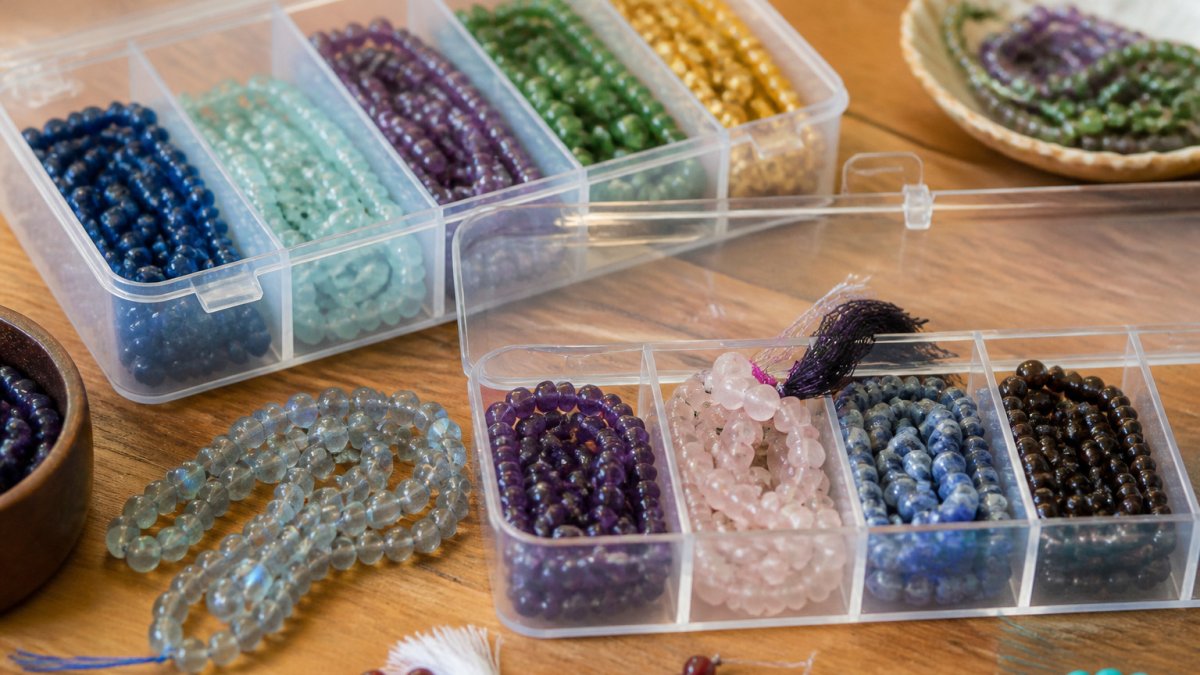
Shape selection matters for your design work. Round beads are the workhorse for standard bracelets and necklaces. Rondelles create elegant spacer patterns between larger beads. Nugget beads offer an organic, tumbled look ideal for casual designs. Chip beads are the most economical option, perfect for layered necklaces or filling gaps in multi-strand pieces. Full-drilled beads are standard for stringing, while some shapes come half-drilled for earring drops or pendants.
How to Identify Real Lapis Lazuli: A Step-by-Step Guide
Authenticity verification is where many buyers get burned. The most common fake is dyed howlite, a white porous stone that absorbs blue dye and mimics lapis at a fraction of the cost (geology.com). The telltale sign is color distribution: dyed howlite shows blue concentrated in surface cracks and pits, while natural lapis has color that runs uniformly through the stone.
Step 1: Examine the color under bright light. Natural lapis shows depth and slight variation across the bead surface. Dyed stones look flat and unnaturally uniform.
Step 2: Look for pyrite inclusions with a magnifying loupe. Real lapis contains small metallic flecks of pyrite that catch the light. Dyed howlite typically lacks these, though some fakes add pyrite fragments to fool buyers.
Step 3: Check the drill holes. On natural stone, the edges of the drill hole show the same blue as the surface. On dyed howlite, the interior often appears white or lighter because the dye didn't penetrate fully.
Step 4: Perform the acetone test on a single bead. Rub a cotton swab dipped in acetone against the stone. If blue dye transfers, the bead is treated or dyed. Natural lapis will not release color.
Step 5: Assess the weight. Lapis lazuli is a dense stone. A strand of genuine lapis will feel noticeably heavier than the same size strand in dyed howlite or resin.
Watch Out The acetone test should only be performed on a bead you are willing to sacrifice or return. Some legitimate lapis is treated with wax or resin to enhance color, and acetone can strip these treatments, altering the bead's appearance.
Selecting the Best Gemstone Beads for Jewelry Making
The best gemstone beads for jewelry making match your design intent without compromising durability. For lapis specifically, consider how the stone's hardness interacts with your planned setting. If wire-wrapping beads, the edges of the drill holes experience friction; lower-grade lapis with heavy calcite may chip or crumble at the hole under pressure.
Bead diameter is a practical decision, not just an aesthetic one. A 2mm to 4mm strand works for delicate spacer accents or dainty bracelets. The 6mm to 8mm range is the sweet spot for standard bracelets and necklaces, offering enough presence to show the stone's color without being bulky. Beads 10mm and larger make bold statement pieces but require more material, raising the strand cost.
Consistency matters when building a commercial line. If you order a 16-inch strand of 8mm rounds, you need every bead to measure close to 8mm across. Poorly calibrated strands force you to sort and discard beads, silently raising your per-piece material cost. Reputable suppliers list bead diameter and piece count per strand so you can calculate exactly how many finished pieces a strand will yield.
Lapis Lazuli Jewelry Design Ideas for Your Next Project
Lapis lazuli jewelry design ideas work best when you lean into the stone's contrast. The deep blue pairs exceptionally well with gold-filled or gold-plated findings, which echo the pyrite inclusions. Silver settings create a cooler, more contemporary look that suits denim-grade stones with softer blue tones. Moving beyond "gold or silver" requires understanding why the pairing works, and how to build a piece that sells.
The color logic behind successful lapis pairings:
Lapis sits at the cool end of the color wheel, so it naturally harmonizes with warm metals (gold, brass, copper) that provide complementary contrast. The golden pyrite flecks create a visual bridge to gold-filled findings, making the metal choice feel intentional. For a monochromatic, high-end look, pair deep royal blue lapis with sterling silver or white gold, the cool tones unify, and the pyrite becomes the only warm accent. Avoid mixing lapis with strongly warm stones like carnelian unless deliberately designing a color-blocked statement; competing temperatures can make the lapis look muddy.
Three specific project builds that sell well:
The "Royal Stack" bracelet. String 6mm lapis rounds on stretch cord (0.8mm or 1.0mm thickness). Between every two lapis beads, add a single 3mm gold-filled rondelle spacer. Finish with a surgeon's knot and a dab of jewelry glue. The small gold spacers echo the pyrite without overwhelming the stone. A 7-inch bracelet uses approximately 24 beads of 6mm lapis, so one 16-inch strand yields roughly two bracelets.
The "Midnight Gradient" necklace. Use a 16-inch strand of mixed-size lapis rounds (4mm, 6mm, 8mm) and string them in ascending order from the clasp toward the center, then descending on the other side. This graduated look adds visual interest without complex knotting. Pair with a simple lobster clasp and a 2-inch extender chain for adjustability. The gradient pattern draws the eye along the necklace and showcases the stone's color variation.
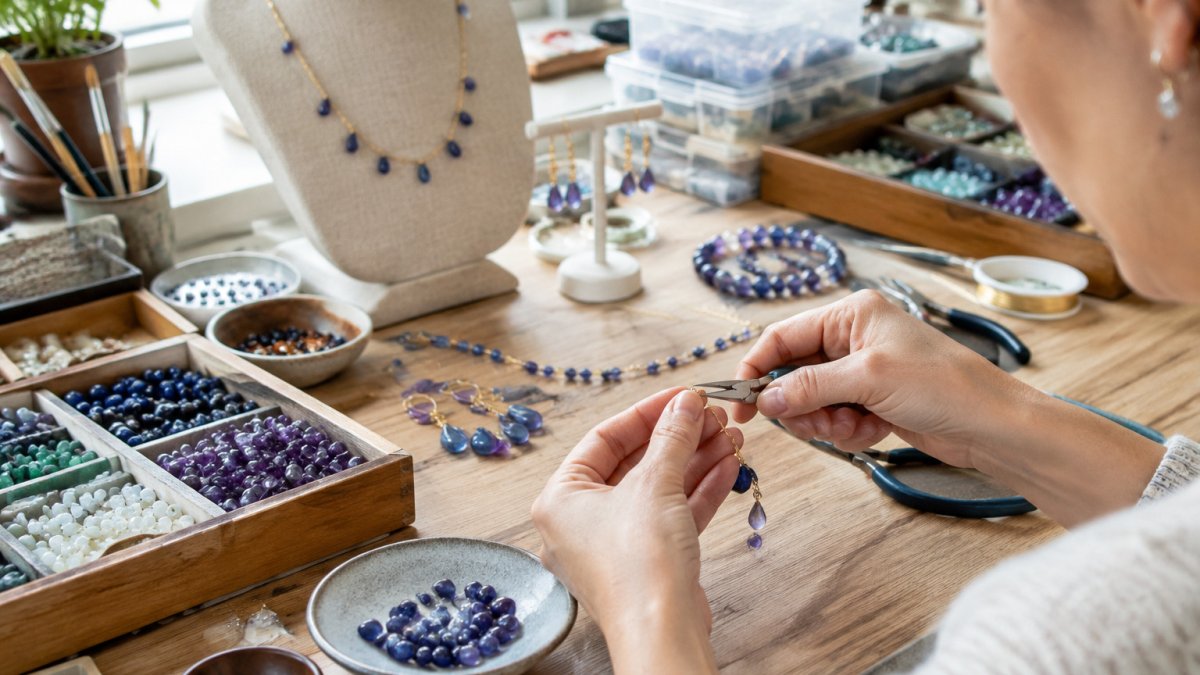
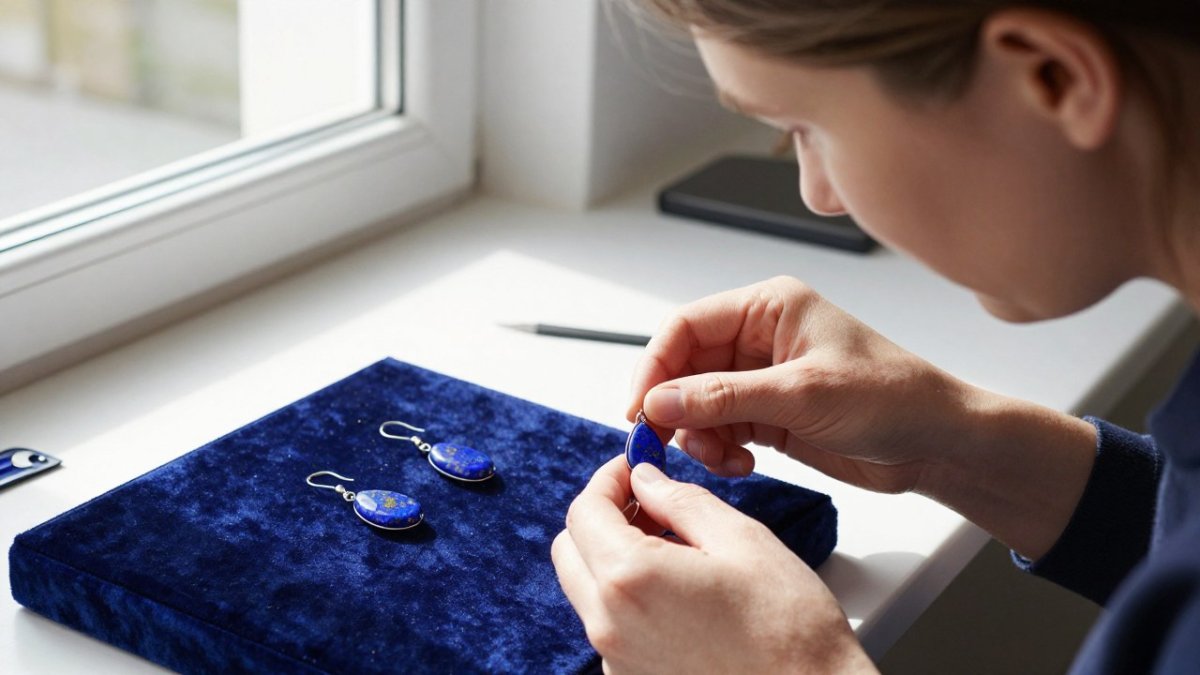
The "Briolette Drop" earrings. Briolette-cut lapis, which is faceted and teardrop-shaped, catches light from every angle. Wire-wrap a single briolette with 24-gauge gold-filled wire, creating a wrapped loop at the top. Attach to a simple ear wire or a small gold-filled hoop. The faceting adds sparkle that rounds and nuggets lack, making briolette ideal for evening pieces. For a matched pair, select two briolettes of similar size and color depth, this is where a curated supplier's consistency pays off.
Metal pairing quick reference:
Gold-filled or gold-plated: Best for royal blue and denim-grade stones; echoes pyrite inclusions; reads as classic and luxurious.
Sterling silver: Best for stones with heavier calcite veining; creates a cooler, more contemporary aesthetic; makes the blue appear brighter.
Raw brass or copper: Best for nugget or chip beads in casual, bohemian designs; the warm metal contrasts sharply with the cool blue for an earthy look.
Rose gold: Use sparingly; the pink tone can clash with the blue unless the lapis has purple undertones. Test a sample pairing before committing to a full line.
Pro Tip When mixing lapis with other stones, stick to materials with similar hardness. Pairing lapis (Mohs 5 to 5.5) with quartz (Mohs 7) in the same bracelet risks the harder quartz scratching the lapis beads over time. Pair lapis with other soft stones like turquoise, coral, or howlite for pieces that wear evenly. If you must mix with harder stones, separate them with metal spacers or use a multi-strand design where the stones do not rub against each other.
Key Takeaway The most appealing lapis designs are often intentional. Choosing one metal, one complementary stone (or none), and letting the lapis be the hero can create a clean design with high-quality stone.
For a classic bracelet design, alternate 8mm lapis rounds with 2mm to 3mm gold-filled rondelle spacers. This pattern gives the lapis room to breathe while adding a metallic rhythm. For a more organic look, string graduated lapis nuggets on leather cord, finishing with a sliding knot closure.
Where to Buy Natural Lapis Lazuli Beads and What to Pay
Pricing for natural lapis lazuli beads for sale varies widely based on grade, size, and source. The range reflects real differences in stone quality, and the cheapest option is rarely the best value once you account for sorting time and rejected beads.
For professional designers, the key is consistency across reorders. If you are building a commercial line around a specific rondelle cut in a specific size, you need a supplier who can guarantee the same dimensions and quality batch after batch. Wholesale specialists who standardize their sizing and grade their stone are the safer bet, even when their per-strand price runs higher than a retail platform listing.
Watch for shipping costs that quietly inflate your total. A strand priced below market rate loses its advantage when you add shipping and handling. HietalaJewelry's free delivery within the USA means the price you see is the price you pay, which simplifies cost calculations for your own pricing. Sale pricing on select strands adds further savings when you are stocking up for a large project.
Final Thoughts on Buying Lapis Lazuli Beads
The lapis lazuli market often rewards buyers who do their homework. Understanding color grades, spotting dyed imitations, and choosing the right bead shape can help save money and frustration. A premium strand of genuine stone can be an investment in your craft, and it often shows in the finished piece.
At HietalaJewelry, we curate natural gemstone beads in the shapes and cuts that elevate professional jewelry work. Our selection of lapis lazuli, available in briolette, rondelle, and marquise, brings authentic royal blue depth to your designs, with sale pricing and free USA delivery making premium materials accessible. Explore the lapis lazuli bead collection at HietalaJewelry and see the difference that quality stone makes in your next commission.
Frequently Asked Questions
How can I tell if lapis lazuli is real?
Check for pyrite inclusions and calcite veins. Real lapis lazuli is rarely uniform; it usually has small flecks of gold pyrite. The color is a deep royal blue, not a bright synthetic blue. Run the stone under water; dyed stones often bleed color. Also, check the price. Very cheap strands are likely dyed howlite or reconstituted material. When buying, look for sellers who clearly state the stone is natural and offer quality details.
What are the signs of high-quality lapis lazuli?
High-quality lapis lazuli features an even, intense royal blue color with minimal calcite (white) veins. Small, fine pyrite flecks are desirable, but large chunks of pyrite can lower the grade. The beads should be well-drilled, polished to a smooth finish, and consistent in size. The highest grades, often labeled AAA, have a deep, uniform color and are prized for jewelry making.
Are lapis lazuli beads durable enough for daily wear jewelry?
Lapis lazuli has a Mohs hardness of 5 to 6, making it softer than quartz but suitable for most jewelry. It is durable enough for earrings, necklaces, and bracelets worn daily. However, avoid exposing it to harsh chemicals, perfumes, or ultrasonic cleaners. To protect your beads, store them separately and clean with a soft, damp cloth.
Are lapis beads worth anything?
Yes, genuine lapis lazuli beads hold value. The price depends on quality, size, and origin. High-grade, deep royal blue stones with fine pyrite inclusions are more valuable than lower-grade, pale stones with heavy calcite. While commercial-grade strands can be affordable, premium AAA-grade strands command higher prices. Their enduring popularity in jewelry design maintains their worth.
Where can I buy ethically sourced natural lapis lazuli beads?
Look for reputable suppliers who are transparent about their sourcing. Established gemstone bead retailers often provide details about stone origins and quality. Read product descriptions carefully for terms like 'natural' and 'genuine'. Check customer reviews for feedback on quality and authenticity. When in doubt, contact the seller directly to ask about their sourcing and quality control processes before placing an order.
Read more
Comments