
How to Scale a Handmade Jewelry Business in 7 Steps
Last Updated: November 4, 2026
Quick Summary
To scale handmade jewelry, build a written business plan with SMART goals, price for profit by covering every cost before adding margin, and sell across multiple channels. Then strengthen repeat sales through collections, control inventory with reorder points, outsource repeatable tasks while keeping design in-house, and protect the business legally.
Write a one or two page business plan with SMART goals for the next 12 months.
Price handmade jewelry to cover materials, labor, packaging, fees and marketing before adding profit.
Spread sales across two or three channels so one platform change cannot wipe out income.
Group designs into collections and send thank-you notes to encourage repeat purchases.
Set a reorder point per SKU using monthly usage, supplier lead time and a safety buffer.
Table of Contents
Why Most Handmade Jewelry Businesses Stall After the First Year
Many handmade jewelry makers hit a wall about twelve months in. Sales come in steadily, friends and first customers keep buying, but growth flattens. The problem is rarely the designs. It is usually the lack of a system for pricing, inventory, selling channels and time.
That is why scaling needs a plan, not just more hours at the bench. The seven steps below cover what most starter guides skip. They focus on the operational side of growth, from pricing and inventory to deciding what to outsource, so you can scale handmade jewelry without burning out.
Step 1: Build a Written Handmade Jewelry Business Plan
A business plan sounds formal, but for a jewelry maker it can be one or two pages. Write down your niche, who buys from you, what you sell, and what you want to earn in the next 12 months.
Set SMART goals inside the plan. A goal like "grow sales" is vague. A goal like "reach $3,000 in monthly revenue by December through two wholesale accounts" tells you what to do next.
Watch out: many makers skip the plan because it feels like paperwork. Without one, every new idea competes for the same limited time.
Step 2: Price Handmade Jewelry for Profit, Not Just Cost
Many makers price by adding up materials and labor, then stopping there. That leaves no room for profit, packaging, platform fees or the time spent on marketing.
A better approach covers every cost and then adds a margin. Track your materials per piece, your hourly labor value, shipping supplies and selling fees. Then set a retail price that leaves a healthy profit after all of them.
Premium gemstone beads also cost more to source, so your margin needs to reflect that. For background on why quality stones cost what they do, see our guide on Why Premium Gemstone Beads Cost More: A 2026 Guide.
Step 3: Sell Handmade Jewelry Online Across Multiple Channels
Relying on one platform is risky. A change in fees or an algorithm update can cut your sales overnight. Spreading across two or three channels protects your income.
Common options include your own website, a marketplace such as Etsy, and social media shops. Each channel reaches different buyers, so pick the ones where your customers already shop.
Shipping affects buyer expectations on every channel. Check realistic delivery windows before you promise anything. Our page on Premium Gemstone Beads Shipping & Delivery Times can help you set accurate timelines.
Step 4: Increase Sales Through Repeat Customers and Collections
Winning a new customer costs more than keeping an existing one, and repeat buyers tend to spend more over time, which is one of the simplest ways to scale handmade jewelry profitably.
Group your designs into collections, such as a bridal set or a birthstone series. Collections give buyers a reason to return and make it easier to offer gift bundles. Browse Handmade Gemstone Bracelets for Women for ideas on how to present a line.
Send a short thank-you note with each order. A small insert with care tips can prompt a return visit.
Step 5: Control Inventory Before It Controls You
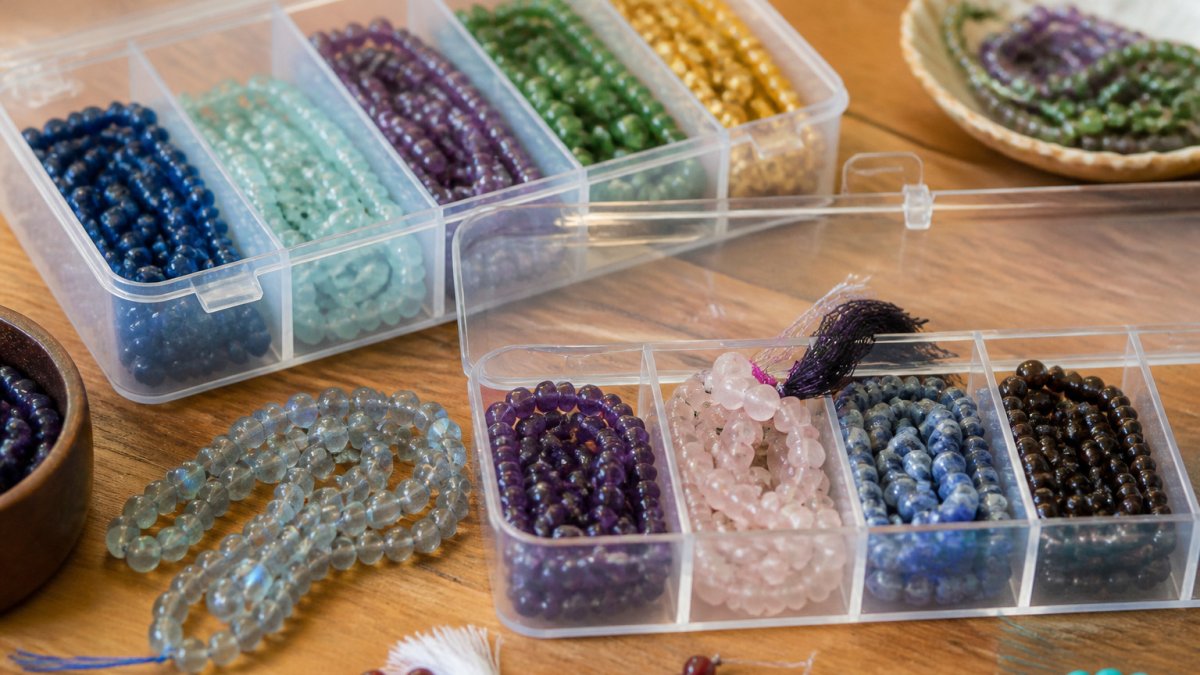
Inventory is where many growing makers lose money, and the problem gets worse as volume rises. Buying too many beads ties up cash in dead stock. Buying too few causes stockouts when a design takes off. The fix is to stop treating inventory as one bucket and start managing it as two: raw materials and finished goods.

Raw materials, beads, wire, findings, chain, packaging, behave differently from finished pieces. Raw stock is a cash asset sitting on a shelf until it becomes a sale. Finished goods are already-committed labor and materials waiting for a buyer. Most handmade jewelers track only one or the other, then wonder why cash feels tight even when sales are up.
A workable system has three parts:
1. A per-SKU reorder point. For each core bead type or finding, calculate average monthly usage, multiply by your supplier lead time in months, and add a safety buffer. If you use 40 feet of sterling silver chain a month and your supplier takes three weeks, your reorder point is roughly 30 feet plus buffer, not zero. Write the number on the bin label so anyone packing orders can flag it.
2. A raw-vs-finished split. Decide what percentage of your cash you are willing to hold as raw material versus finished goods. A common pattern is to keep raw stock lean and finished goods closer to demand, because finished pieces can be sold while raw beads cannot. Review the split monthly and shift cash toward whichever side is starving.
3. A monthly usage review. Once a month, count what you actually used versus what you bought. The gap is either waste, shrinkage, or a design that is quietly outselling your forecast. Adjust reorder points from real usage, not from memory.
Watch out: bulk discounts on beads are only a saving if you will use the material within its shelf life and before styles change. A 30% discount on beads you sit on for two years is a loss, not a win.
For a practical look at stocking beads without overbuying, read Wholesale Gemstone Bead Buying Tips: A 2026 Guide.
The article breaks inventory management into a few concrete checks a maker can run each month.
Check | What to do | Frequency |
Reorder point | Average monthly usage × supplier lead time, plus a buffer | Per SKU |
Raw vs finished split | Decide the cash share held as raw material versus finished goods | Monthly review |
Usage review | Compare what you bought with what you actually used | Monthly |
Bulk discounts | Buy only what you will use within shelf life and before styles change | Each purchase |
Step 6: Decide What to Outsource and What to Keep In-House
Every hour spent on packing, bookkeeping or photo editing is an hour not spent designing. At some point, outsourcing those tasks pays for itself. The hard part is knowing which tasks to hand off and which to guard, because the wrong call either erodes your brand or keeps you chained to the bench.
The cleanest rule is this: outsource work that is repeatable and does not touch the customer's perception of your craft. Keep in-house anything that defines how a piece looks, feels or arrives.
Keep in-house: design, final assembly, stone setting, quality checks, and the packaging insert that carries your voice. These are the parts a customer would notice if they changed.
Consider outsourcing: product photo editing, bookkeeping and bookkeeping-adjacent tasks, listing copy drafts, shipping-label prep, and some repetitive packaging steps like folding boxes or cutting tissue. These are time sinks that do not change what the piece is.
The threshold test. Before outsourcing a task, estimate its hourly cost to you versus the hourly rate of someone else doing it. If you can bill your own time at a higher rate on design or sales, outsourcing the lower-value task is rational even at a modest volume. If you cannot yet fill your own hours with higher-value work, outsourcing may just add cost.
Quality control is the trade-off. Outsourced photo editing can drift from your brand's look. Outsourced bookkeeping can miss category details your accountant needs. Build a short checklist for every outsourced task and review the first three deliverables closely before you trust the workflow.
Watch out: outsourcing final assembly or stone setting to save time is the most common way handmade brands lose the thing that made them sell, inconsistent quality that customers notice before you do.
Our guide to Professional Jewelry Making Supply Tips covers which materials are worth buying ready-made and which are better made from scratch.
Step 7: Protect the Business With Legal and Insurance Basics
As sales grow, so does your exposure. A customer may claim a piece was damaged, or a supplier may dispute an invoice. Basic protection matters.
Check whether your city or state requires a business license, and register for a sales tax permit if you sell taxable goods. Learn the rules for collecting sales tax from your state revenue department. Consider general liability insurance once you sell wholesale or at events.
Keep clean records of sales, expenses and supplier invoices from day one (Taking care of business: recordkeeping for small businesses). That makes tax filing easier and strengthens your position if a dispute ever arises.
Frequently Asked Questions
How do I scale a handmade jewelry business?
Scaling a handmade jewelry business means growing revenue without your hours growing at the same rate. Start by documenting your best-selling designs and their costs so you know which products deserve more production time. Then expand into one or two additional sales channels, standardize your materials sourcing so reorders stay consistent, and build a simple monthly review of sales, margins and inventory. Pricing should cover materials, time and overhead, and should be reviewed as costs change. Growth usually comes from doing a few things reliably rather than launching many new products at once.
How can I increase sales for my handmade jewelry business?
The most reliable way to increase sales for a handmade jewelry business is to bring existing customers back. Offer collections that let buyers add matching pieces, send order updates and thank-you notes, and create a small loyalty incentive such as early access to new designs. On the acquisition side, test one or two channels well instead of spreading thin across many. Track which product photos, descriptions and promotions convert browsers into buyers, and keep the changes that measurably improve conversion rate.
How do I sell handmade jewelry online?
Most makers start with a dedicated online store on a hosted e-commerce platform, then add marketplaces and social selling as volume grows. Clear, well-lit product photography and specific descriptions of materials and dimensions reduce returns and questions. Ship quickly, include care instructions and a tracking number, and set realistic delivery times on your product pages. Consistent posting on the social channels where your buyers already spend time will drive more traffic than sporadic campaigns.
What should a handmade jewelry business plan include?
A useful handmade jewelry business plan covers your brand identity and target customer, your product line and pricing logic, your sourcing suppliers and lead times, and your sales channels. Add a simple financial section with monthly revenue targets, material and shipping costs, and a realistic forecast for the next 12 months. Include your goals as specific, measurable targets, such as a monthly sales figure or a number of wholesale accounts, and review the plan every quarter.

Comments