
How to Design Modern Jewelry with Birthstones
Last Updated: November 4, 2026
Quick Summary
Start with the stone shape, since briolette, rondelle, and marquise cuts each suit different pieces. Then plan a restrained layout, choose a setting that protects the stone, and make a one-page spec sheet before ordering. Modern jewelry works best when the stone leads and the metal supports it.
Choose the bead shape first: briolettes suit drops, rondelles suit stacks, marquises suit rings.
Measure beads with calipers and order a small test batch before any bulk purchase.
Write a one-page spec sheet covering stone, setting, metal, chain, and finish.
Prototype in brass, copper, or resin and wear-test it for a week before finishing.
Limit the palette to about two colors so the piece stays clean and cohesive.
Table of Contents
Modern jewelry lives or dies on its stones, and a birthstone design is no exception.
How to design modern jewelry with birthstones begins with one question: what shape sits at the center?
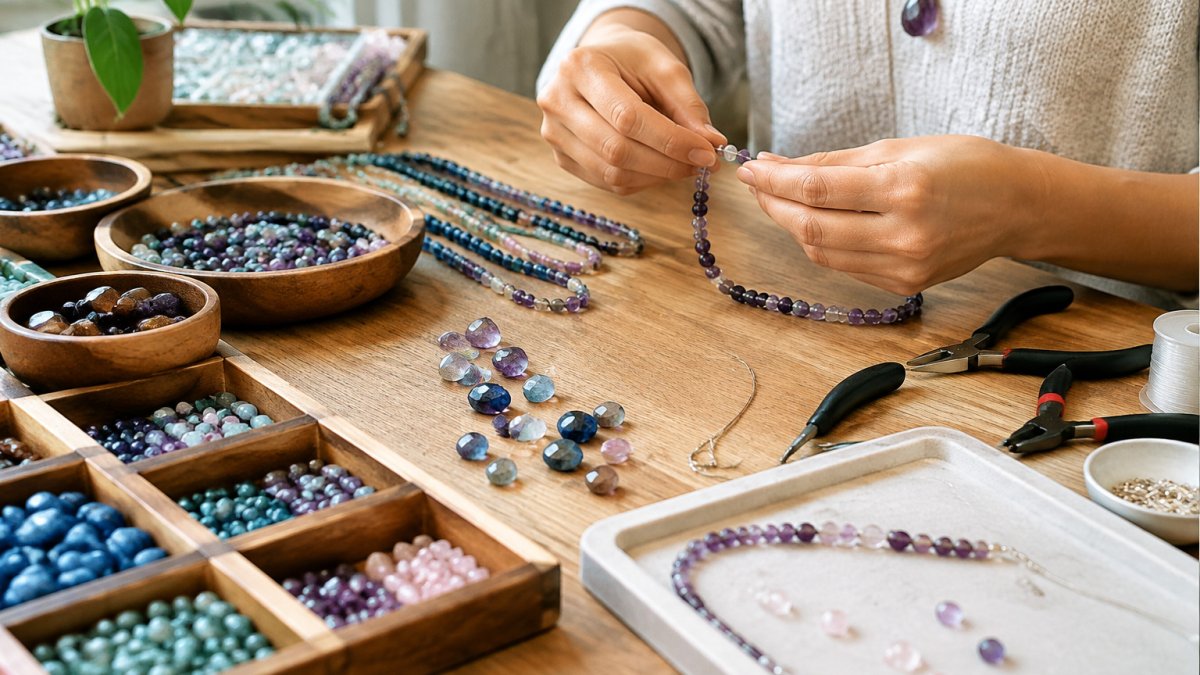
Briolette, rondelle, and marquise are the shapes most makers reach for first. Each changes how light moves across the stone and how the piece sits.
Briolette, Rondelle, and Marquise: Which Cut Suits Which Design
A briolette is a teardrop-shaped bead faceted all over.
A rondelle is a flat, disc-like bead that sits neatly between other beads or mounts flat in a simple setting.
A marquise is an oval with pointed ends.
Briolette: Drop earrings, pendants, statement drops
Rondelle: Stacked bracelets, strand necklaces, flat-set accents
Marquise: Rings, linear pendants, bar-style earrings
Watch out: Pointed shapes like the marquise chip more easily at the tips. Choose a setting that protects those points.
Checking Natural Stones and Consistent Sizing Before You Buy
Consistency matters most when you build a line, not a single piece. A commission needing twelve matching rondelles fails if sizes drift bead to bead.
Before you buy, check a few things:
Confirm the stone is natural and ask how it was sourced
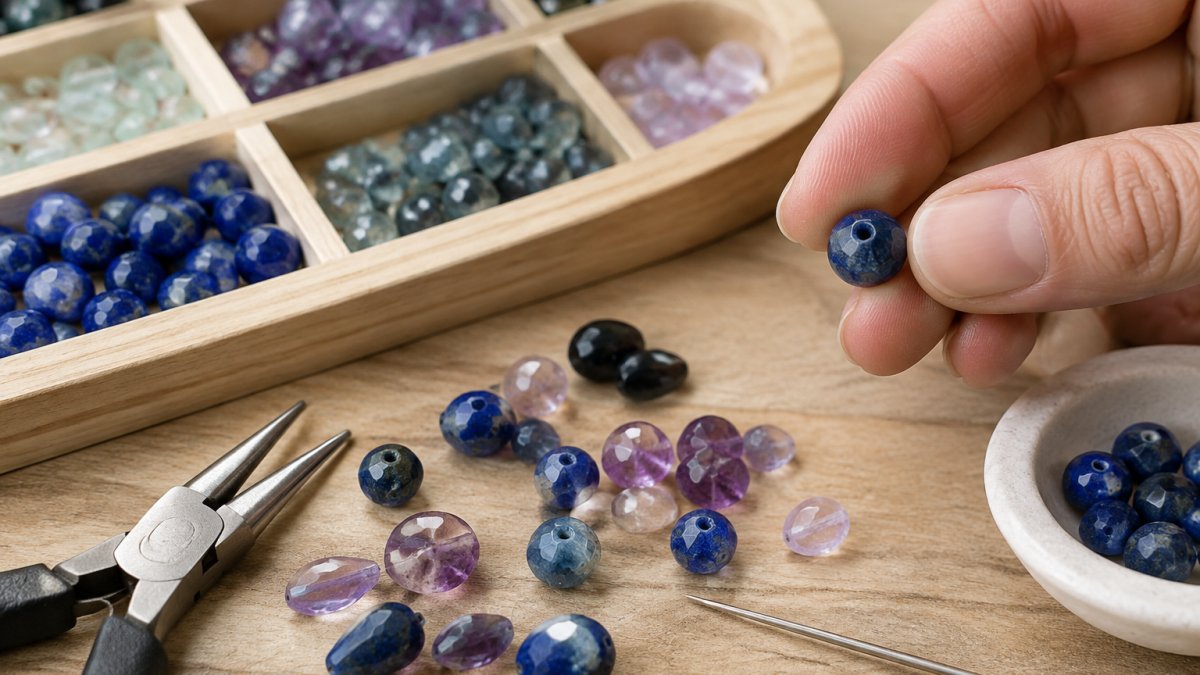
Measure a sample of beads with calipers, not by eye
Compare drill holes, since uneven drilling makes stringing and setting harder
Buy one sample of each size first. Measure it, set it in your design, and wear-test it before a bulk order. Check current stock and pricing on the HietalaJewelry website before planning a production run.
Planning a Minimalist Birthstone Design Step by Step
Minimalist design asks a lot of the maker: with fewer elements, every choice shows, and a stray gap or crowded stone stands out.
The practical gap is the workflow between sketch and bench: translating a concept into measurements, stone specifications, and a handoff packet a jeweler or caster can build from.
Step 1: Define the Wearer and the Wear Case
Before you draw, write one sentence naming who wears the piece and when. For example: "A 30-something office worker who wants a daily-wear pendant that survives a keyboard and a gym bag." That sentence drives stone hardness, setting style, and chain weight.
Skipping this step and designing for a photo often fails in daily wear: the stone is too soft, the setting catches on clothing, or the chain is too fine for the pendant's weight.
Step 2: Lock the Stone Specification
Write down the stone's species, shape, millimeter dimensions, carat weight (if known), cut style, and treatment status. For a briolette, note drill direction (top- or side-drilled) and hole diameter. For a marquise, note the length-to-width ratio.
Use calipers, not a ruler. A 0.2 mm difference across twelve beads is visible in a finished strand.
Step 3: Sketch at True Size and Mark the Metal
Draw the piece at actual size, marking the stone's footprint, the bezel or prong footprint, and attachment points for chain, band, or post.
A simple rule: the stone should occupy roughly one-third to one-half of the visible face of a minimalist pendant or ring. Too little metal looks busy; too much makes the stone an afterthought.
Step 4: Choose the Setting Family Before the Metal
The setting determines how much metal surrounds the stone, which in turn determines the piece's visual weight. Bezel settings read heavier and protect edges. Prong settings read lighter and expose more stone. Flush settings read flattest and suit small accent stones. Decide the setting family before the metal color, because a heavy bezel in bright yellow gold can overwhelm a pale stone.
Step 5: Build a One-Page Spec Sheet
A spec sheet is the handoff document. Include:
A true-size sketch with dimensions in millimeters
Stone species, shape, dimensions, quantity, and drill details
Setting family and metal type (for example, 14k yellow gold, sterling silver)
A one-page spec sheet helps bench jewelers and CAD designers work from clear, accurate information. If using CAD, request a true-scale render and a dimensioned drawing before approving the model.
Step 6: Prototype in a Cheap Material First
Before committing to metal and stone, prototype the layout in brass, copper, or 3D-printed resin. Wear it for a week and check where it catches on clothing, how the stone sits against skin, and whether the chain length matches the wearer's necklines.
Watch out: A prototype that looks right on a table often fails on the body because the stone sits too high, the chain is too short, or the setting edge is sharper than expected.
Step 7: Order a Sample Run and Test the Finished Piece
Test a finished piece in the final materials. Measure it against the spec sheet and wear-test it for at least a week before scaling to a production run. This catches sizing drift, setting failures, and finish issues before they multiply.
Balancing Birthstone Colors in a Restrained Palette
Color can carry a minimalist piece; a single strong stone does more work than a dozen small accents.
Mixing colors that compete for attention, bright sapphire next to vivid emerald, can look loud in a small piece.
Watch out: Mixing many stone colors in one small piece often makes it look cluttered, even when each stone is beautiful on its own.
Modern Jewelry Setting Techniques That Showcase Birthstones
The setting holds the stone and shapes how it looks. In modern jewelry, it should feel quiet and precise, letting the stone do the talking, but it is also structural, determining protection, light, and how easily the piece can be repaired or reset.

The practical gap is construction: which setting suits which stone shape and size, how it affects wearability, and what to specify to a bench jeweler.
Bezel Settings: Protection and Clean Lines
A bezel surrounds the stone with a thin rim of metal, full or partial. Full bezels protect the girdle and edges, making them strong for softer stones and daily-wear rings.
Bezels work well for rondelles, cabochons, and any stone with a fragile edge, and suit minimalist designs with a clean outline. The trade-off: a bezel hides the girdle and can make a small stone look smaller.
Prong Settings: Maximum Light and Sparkle
Prong settings hold the stone with small metal claws. Four-prong settings suit round and oval stones; six-prong adds security for larger stones.
The trade-off is exposure: prongs catch on clothing and hair, and a loose prong lets the stone shift or fall out.
Specify prong count, prong thickness, and the height of the stone above the metal.
Flush and Tension Settings: Sleek but Demanding
Flush settings sit the stone into the metal with no visible prongs, the table roughly level with the surface. They look very modern and suit small accent stones in bands and pendants because they catch on nothing.
Tension settings hold the stone by compressive force between two metal shoulders. They look dramatic and expose most of the stone, but require precise metal tension and a stone that withstands the pressure. Not every shape or species suits them, and repairs are more complex.
Both flush and tension settings require skill and the right stone shape; ask a skilled bench jeweler if you are still learning.
Matching Setting to Stone Hardness and Wear Case
Hardness (Mohs) measures scratch resistance; toughness measures resistance to chipping. A stone can be hard but brittle, or softer but tough.
A practical way to choose:
Bezel: Best for durability and clean lines; suits softer stones and active wearers
Prong: Best for maximum light and sparkle; suits faceted stones in pendants and earrings
Flush: Best for small accent stones and low-profile bands
Setting affects wear: a deep bezel protects an edge that would catch on clothing, while a high prong exposes the girdle to knocks.
Watch out: a setting that looks secure on a bench can loosen after weeks of wear if prongs are too thin or the bezel wall too shallow.
Pairing Metals and Chains for a Contemporary Look
Metal and chain choices finish the piece and affect the overall tone, so think about them early.
Engage Studio
Yellow gold gives a warm, classic feel and pairs well with deep-colored stones.
Chains matter as much as metal.
Many makers mix metals on purpose, such as a gold setting on a silver chain.
Use one clear rule as your guide: let the stone lead, and let the metal support it.
Durability, Everyday Wear, and Caring for Birthstone Pieces
A beautiful piece must also survive daily life. Birthstones vary in hardness, so pick settings and wear habits that protect the stone.
Softer stones scratch more easily and need gentler care; harder stones hold up better to knocks.
Simple care habits extend a piece's life:
Remove jewelry before cleaning, gardening, or exercise
Store pieces separately so stones do not scratch each other
Clean with warm water and a soft brush, avoiding harsh chemicals
A design that protects its stone earns repeat buyers. Include care instructions with pieces you sell.
The article's main points on protecting a piece through everyday wear, summarised for quick reference:
Care habit | Why it matters | When to do it |
Remove jewelry | Protects the stone from knocks | Before cleaning, gardening, or exercise |
Store pieces separately | Stones do not scratch each other | Whenever not worn |
Clean with warm water | Avoids harsh chemicals | Regularly, with a soft brush |
Check prongs and settings | Catches loose settings early | Periodically |
Designing Within Budget and Producing Your Birthstone Piece
Budget shapes every design decision. A smaller stone or simpler setting can keep a piece affordable without losing its modern look.
Pricing depends on quantity, dates, and delivery. For current prices, visit the HietalaJewelry website.
A practical production approach:
Set your target retail price
Work backward to the materials budget
Choose stone size and metal to fit that budget
Order a sample run and test the finished piece
Scale up once the design works
Hobbyists can start with a single piece for friends. Professionals can plan a full line. The same workflow serves both.
Order Your Stones and Start Your Next Birthstone Design
You now have the steps: pick the stone shape, plan the layout, choose the setting and metal, and design for wear and budget.
At HietalaJewelry, you can browse a curated selection of natural gemstone beads, including briolette, rondelle, and marquise shapes. Free delivery within the USA is available. Read more on our website.
Frequently Asked Questions
How do I choose high-quality gemstone beads for custom designs?
Start by checking that the listing describes the stone as natural and identifies the species, such as lapis lazuli, amethyst, or sapphire. Ask for dimensions in millimeters so you can confirm that rondelles or marquise shapes match your drawing. Compare drill quality, surface polish, and whether photos show the actual batch. For commission work, inspect a small sample for cracks and off-center holes before buying a full quantity. Consistent sizing across reorders matters most for commercial lines.
How do I balance birthstone colors in a minimalist design?
Limit the palette to one dominant birthstone and one accent, then let the metal do the rest of the work. Two stones with similar saturation often look more intentional than three bright ones. Place the strongest color at the focal point, such as the pendant, and use smaller or paler stones around it. Keep the metal consistent, whether gold, silver, or rose gold, so the colors read as a deliberate set rather than a scatter of unrelated tones.
What are the best gemstone shapes for contemporary jewelry?
Briolettes add movement and reflect light from many angles, which suits drop earrings and pendants. Rondelles offer clean, geometric repetition, making them useful for spacer-style bracelets and layered necklaces. Marquise cuts create an elongated focal point that works well in bezel-set rings and modern pendants. Choose the shape based on how the piece will be worn and how much visual weight you want the stone to carry.
Are birthstone necklaces still considered trendy in 2026?
Birthstone necklaces remain popular because they combine personal meaning with simple, wearable design. Modern versions tend to use a single small stone on a fine chain, clean lines, and understated metals. Buyers often choose them as gifts for family members or to mark a milestone. Trends shift, but a minimalist setup with a well-cut natural stone tends to stay current.
Note: Each buyer's needs differ. Confirm current availability, shipping times and pricing directly with HietalaJewelry before you plan a production run.

Comments