
How to Start a Handmade Gemstone Jewelry Business
Last Updated: November 6, 2026
Quick Summary
To start a handmade gemstone jewelry business, first pick a niche you can explain in one sentence and a target customer. Then start small with basic tools, a few beads and a free storefront, and sell a first batch before buying more. Track every cost from day one.
Pick a niche you can explain in one sentence, such as hand-wired lapis lazuli earrings for everyday wear.
Start with basic tools, a small stock of beads in one or two colors, and a free or low-cost storefront.
Sell a small first batch before buying more, and use the income to fund the next round.
Verify gemstones by checking species naming, treatment disclosure, and sample-order inspection before buying in bulk.
Price with the formula Price = (Materials + Labor + Overhead + Fees) ÷ (1 − Target Margin), not a simple markup.
Table of Contents
Choosing Your Gemstone Niche and Target Customer
Starting a handmade gemstone jewelry business begins with one decision: who you are making for. Most new makers skip this step and end up selling a little of everything to everyone. That rarely works.
Pick a niche you can explain in one sentence. "Hand-wired lapis lazuli earrings for everyday wear" is a niche. "Jewelry" is not.
Your target customer shapes your stone choices, price points and photos. Ask yourself:
Who buys this style, and how much do they usually spend?
Do they want bold statement pieces or quiet everyday wear?
Where do they already shop online?
A common mistake is choosing a niche because it looks pretty on Instagram. Check whether real buyers are searching for it first.
Watch out: Choosing a niche that depends on a single stone type can leave you exposed if that stone's supply tightens or its price jumps.
How to Start a Handmade Gemstone Jewelry Business With No Money
You do not need a large budget to begin. Many makers start with a few tools, a small stock of beads and a free online shop.
Start with these basics:
Pliers, wire cutters and a bead board
A small set of beads in one or two colors
A free or low-cost storefront on an existing marketplace
Sell a small first batch before buying more. Use the income to fund the next round. This keeps your risk low while you learn what customers want.
Costs add up fast when you are not careful, so track every purchase from day one. A simple spreadsheet is enough.
Sourcing Gemstones, Metals, and Findings From Reliable Suppliers
Your product is only as good as the materials inside it, and gemstone sourcing carries risks that plain metal-and-findings buying does not. For a vetted list, see reliable gemstone bead suppliers for artisans.

Start by separating your supply list into three categories, because each has different vetting needs:
Gemstones, the highest-risk category for misdescription, treatment, and origin claims
Metals, sterling silver, gold-filled, and base metals; verify stamping and alloy claims
Findings, clasps, ear wires, jump rings, and chain; check gauge, finish, and tarnish resistance
For gemstones specifically, look for these signs of a reliable supplier:
Species-level identification on every listing ("natural amethyst" rather than "purple gemstone")
Explicit treatment disclosure, heat, dye, irradiation, stabilization, or fracture filling (the FTC)
Whether the stone is natural, lab-created, or imitation, stated plainly
Consistent millimeter sizing and drill-hole diameter from one order to the next
Real photos of the actual lot, not a stock image reused across products
A written return policy that covers stones arriving damaged or not matching the listing
Responsive answers to pre-purchase questions about origin and treatment
How to Verify Gemstones Are Natural and Accurately Described
Verification is a process, not a single check. Most practitioners use a layered approach because no single test proves a stone is natural.
Step 1, Read the listing like a skeptic. Look for hedging language such as "genuine-style," "amethyst color," or "natural*" with a footnote. Those are red flags.
Step 2, Ask for documentation. For higher-value stones, request the supplier's treatment disclosure and, where available, a lab report from a recognized gemological laboratory.
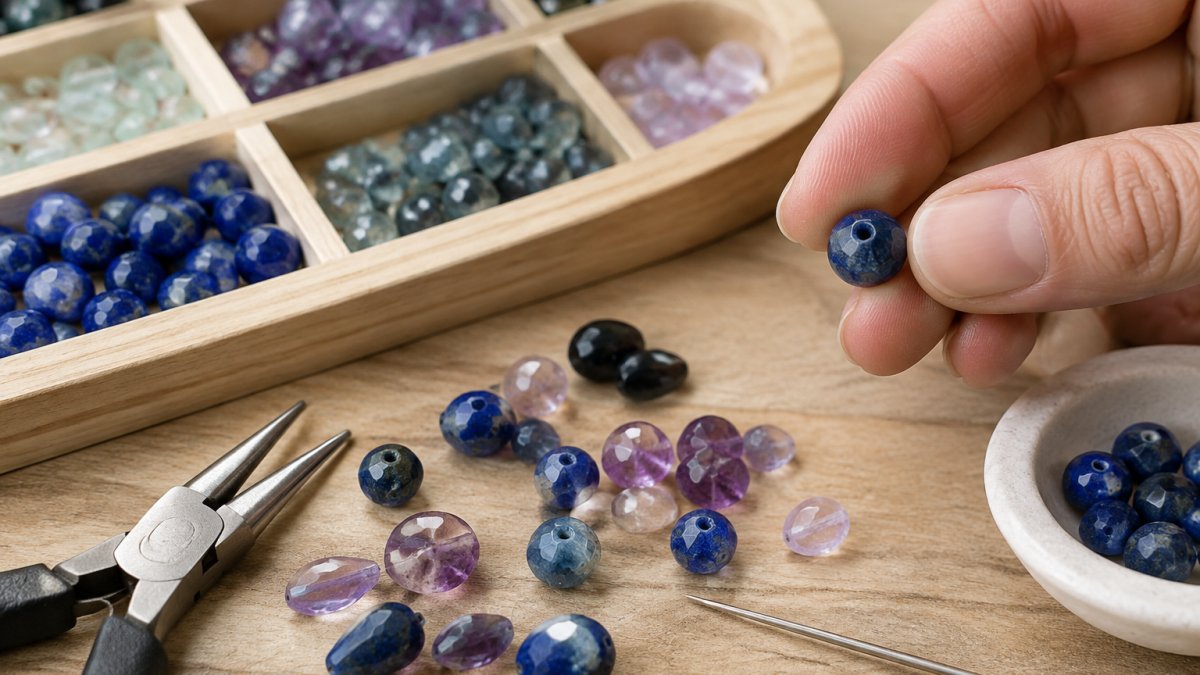
Step 3, Inspect a sample order. Before committing to a larger purchase, buy a small lot and check:
Color consistency across the strand, natural stones vary; perfectly uniform color can signal dyeing
Drill holes for chips, off-center drilling, and roughness that could fray wire
Surface for fractures, pits, or fill material visible under a loupe
Weight and heft against what you expect for that species and size
Step 4, Cross-check price against the market. If a supplier's price for a stated species and grade sits far below several other suppliers, treat that as a signal to verify rather than a bargain to grab.
Step 5, Keep records. Save the listing, the invoice, and any treatment statement for every lot. If a customer later questions a stone, your documentation is your defense.
Watch out: Listing a stone as natural when it is dyed, heat-treated, or lab-created can trigger returns, chargebacks, and platform disputes, and in some cases consumer-protection claims.
Buying Metals and Findings Without Getting Burned
Metals carry their own verification needs. Ask suppliers how they package to prevent tarnish in transit, and test a small order for clasp tension and ear-wire stiffness before you build a collection around them.
Check the HietalaJewelry website for current prices and shipping details, since pricing depends on quantity and sale timing.
The article lists the main supplier vetting signs and the three supply categories to check, summarised below.
Supply category | Main verification concern | Example check |
Gemstones | Misdescription, treatment, origin claims | Species named, treatment disclosed |
Metals | Stamping and alloy claims | Verify stamping |
Findings | Gauge, finish, tarnish resistance | Check gauge and finish |
Gemstone listing | Vague or hedged wording | Avoid "genuine-style" or "amethyst color" |
Sample order | Color consistency, drilling, fractures | Inspect with a loupe |
Writing a Handmade Jewelry Business Plan
A simple business plan keeps you focused. Write down your niche, your target customer, your startup budget and your monthly sales goal.
Include these sections:
Products you will sell and their price range
Materials and suppliers you will use
Startup costs and how you will fund them
Sales channels and marketing plan
Review the plan every three months. Update your numbers based on what actually sold.
How to Price Handmade Jewelry Using Materials, Labor, and Margin
Gemstone jewelry pricing has a wrinkle that plain metal or bead jewelry does not: stone cost is variable, and a single strand rarely yields a clean per-piece cost. A strand of briolette beads may give you 18 usable stones and 4 that are chipped or off-color, so your true per-stone cost is higher than the sticker price divided by the count. Build that waste into your math from the start.
Use this structure:
Price = (Materials + Labor + Overhead + Fees) ÷ (1 − Target Margin)
That is a margin-based formula, not a markup multiplier. A 2x multiplier on cost gives you a 50% margin; a 3x multiplier gives you about 67%. Decide which margin you need to stay profitable, then solve for price.
A Worked Example
Here is a hypothetical pair of hand-wired gemstone earrings to show how the numbers fit together. The figures are illustrative, not a quote from any supplier.
Stones: the cost of one strand, divided by the number of usable stones after discarding chipped or off-color pieces, gives your true cost per stone. Two stones per pair sets the stone cost for the pair.
Wire and findings: about $0.60 per pair for wire, ear wires, and a jump ring.
Packaging: about $0.75 per pair for a box, tissue, and care card.
Shipping supplies: about $0.50 per order allocated across a multi-piece order.
Labor: 25 minutes at $20/hour = $8.33.
Platform and payment fees: assume 10% of the sale price.
Subtotal before fees and margin: $2.40 + $0.60 + $0.75 + $0.50 + $8.33 = $12.58.
If you want a 60% margin and expect fees at 10% of price, solve:
Price = ($12.58) ÷ (1 − 0.60 − 0.10) = $12.58 ÷ 0.30 ≈ $41.93
Round to $42. At that price, fees take about $4.20, leaving roughly $25.22 after the $12.58 in costs, a margin near 60%. If the market will not support $42, you have three levers: reduce labor time, buy stones at a lower per-usable-stone cost, or accept a lower margin. Do not simply cut the price and hope volume covers it.
Gemstone-Specific Cost Variables to Track
Waste and yield: record how many usable stones you get per strand, not just the strand price
Grade and size: a 10mm stone costs more than an 8mm of the same species; price by size band
Treatment and origin: treated stones usually cost less than untreated; do not price a dyed stone as if it were natural
Breakage during setting: wire-wrapped and prong-set stones can crack; build a small breakage allowance into your materials line
Returns and remakes: set aside a small percentage of revenue for the occasional repair or replacement
Test Prices Against Real Listings
Pricing depends on your market, so check current listings for comparable handmade pieces rather than relying on a set number. Compare like for like, same species, similar size, similar setting, and note whether the listing includes shipping. A $38 earring with $6 shipping is not cheaper than a $42 earring with free shipping.
Watch out: Pricing below your true cost to win a sale is the most common way new makers stall out. If a price does not cover materials, labor, fees, and a margin, every sale digs the hole deeper.
Launching Online: Sales Channels and Your First Collection
Choose one or two sales channels to start. Marketplaces give you existing traffic. Your own online store gives you more control over branding and margins.
For your first collection:
Make 8 to 12 pieces that share one style
Photograph each piece in natural light against a simple background
Write descriptions that name the stone, its size and any treatments
Launch with a small, consistent collection. Customers remember a clear style faster than a random mix.
Booking Your First Small-Batch Gemstone Order
Start your first order small. Ordering a limited batch lets you test quality, color match and drill accuracy before you commit to a larger run. Follow the small batch gemstone bead ordering guide to place it step by step.
Plan your order this way:
Choose the shape and size you need for your first collection
Order a small quantity of each stone
Inspect every bead for cracks, drilling and color
Record which suppliers and sizes worked best
Small-batch ordering also helps you keep inventory manageable while you grow. Once you know which stones sell, reorder in larger quantities.
Frequently Asked Questions
Is a handmade jewelry business profitable?
It can be, but profit depends on your materials cost, how long each piece takes you to make, and where you sell. Gemstone pieces carry higher material costs than basic beadwork, so margins are thinner unless you price for the stone's value and your time. Track each piece's full cost from the start, including packaging and shipping, and compare your net income against the hours you spend. Many makers find that a focused collection sold through a single online store earns more than a wide range sold at low prices.
How do I price my handmade gemstone jewelry?
Add up the cost of stones, metal, findings, packaging, and a fair hourly rate for your labor, then apply a markup that covers platform fees, overhead, and profit. A common approach is to multiply your total cost by a factor you can sustain after fees, then compare the result with similar handmade pieces to confirm it is competitive. Pricing depends on quantity, stone quality, and the sales channel you choose, so test a few price points on a small batch before committing to a full line.
Where can I sell handmade gemstone jewelry online?
You can start on an established marketplace to reach shoppers quickly, or build your own online store for full control over branding, pricing, and customer data. Many makers use both: a marketplace for discovery and an owned store for repeat customers. Choose the channel whose fees and audience fit your price point, and write clear product descriptions that state whether each stone is natural, treated, or lab-created.
How do I find reliable gemstone bead suppliers?
Look for suppliers who describe each stone's species, origin, and any treatments, and who provide close-up photos that match what you will receive. Order a small sample first to check drilling quality, consistency in size, and cracks before buying in bulk. Ask about return policies and whether dimensions repeat across reorders, since consistent rondelle or marquise cuts matter for commercial lines. For current pricing, quantities, and delivery timing, check the HietalaJewelry website or request a quote directly.
Comments