
Professional Jewelry Making Supply Tips
Table of Contents
Best Gemstone Beads for Jewelry Making
How to Spot Natural Stones vs. Treated or Lab-Created
Briolette, Rondelle, and Marquise: Matching Cuts to Designs
Essential Jewelry Making Tools for Beginners
Which Pliers, Cutters, and Measuring Tools Actually Get Used
When to Upgrade from Hobbyist to Professional Tools
Jewelry Making Supply Organization Tips for a Working Studio
Labeling, Bead Boards, and Small-Parts Storage
Tracking Supply Costs and Reorder Points
Tool Maintenance and Longevity: Protecting Your Investment
Sustainable and Ethical Sourcing for Jewelry Supplies
Inventory Management for Small Jewelry Businesses
Scaling from Hobbyist to Professional with Jewelry Supply Tips
Frequently Asked Questions
Last Updated: October 1, 2026
Best Gemstone Beads for Jewelry Making
The best gemstone beads for jewelry making balance natural beauty, consistent drilling, and cuts that suit your design. At HietalaJewelry, we see three questions decide every bead purchase: is the stone natural, does the cut match the design, and will the next batch match this one? This guide to professional jewelry making supply tips answers all three, from spotting treated stones to scaling a studio.

How to Spot Natural Stones vs. Treated or Lab-Created
Natural gemstones are stones formed in the earth and cut without artificial color or structure changes. Treated stones are natural but enhanced; lab-created stones share the chemistry but not the origin.
A few quick checks separate them:
Look for inclusions. Natural stones usually show small internal flaws; perfectly clean, uniform strands at low prices are a warning sign.
Check color consistency. Dyed strands often have color pooled in cracks.
Ask directly. Reputable sellers state whether stones are natural, treated, or lab-created.
Compare weight and temperature. Natural stones feel cool and dense in the hand.
Briolette, Rondelle, and Marquise: Matching Cuts to Designs
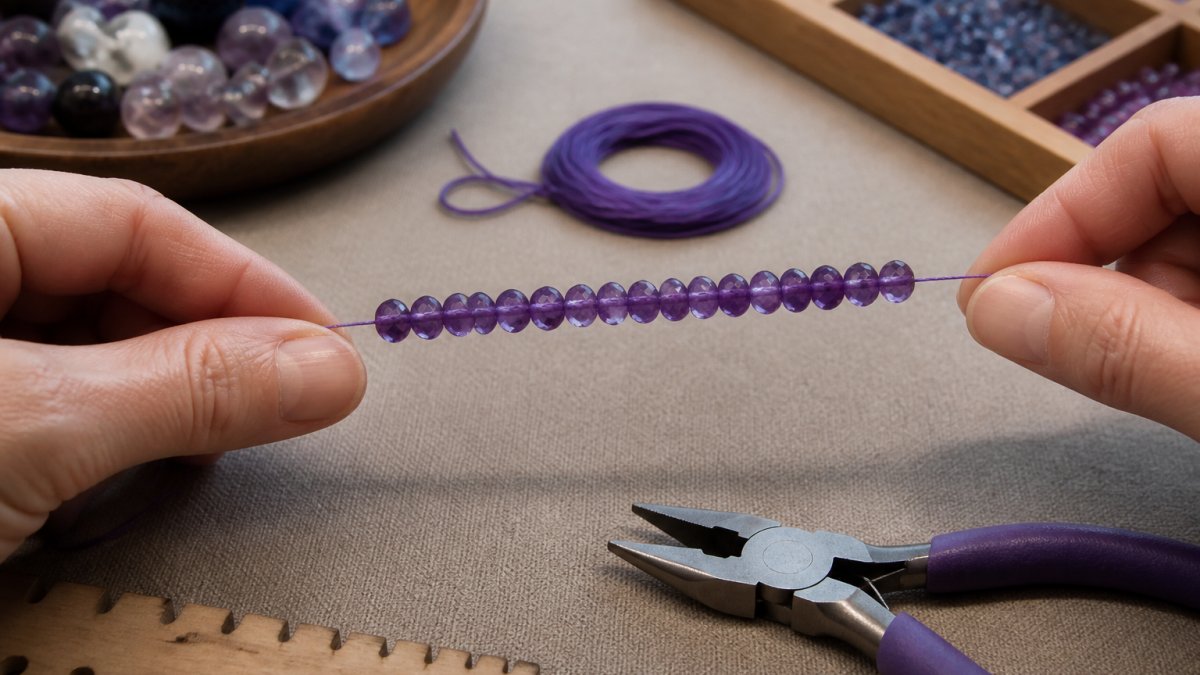
Each cut solves a different design problem. Briolette beads are teardrop-shaped and fully drilled, so they hang and catch light in drops and pendants. Rondelle beads are flattened rounds that sit neatly between larger stones, which makes them ideal for spacers and consistent commercial lines. Marquise beads carry a pointed oval shape that draws the eye along a necklace.
Essential Jewelry Making Tools for Beginners
The essential jewelry making tools for beginners are a small set: two pairs of pliers, a cutter, and a measuring tool. Everything else can wait. Beginners who buy a 40-piece kit usually use six of the tools and fight with the rest.
Here is what actually gets used at the bench:
Chain-nose pliers for gripping, opening jump rings, and bending wire.
Round-nose pliers for forming loops on ear wires and headpins.
Flat-nose pliers for holding and flattening crimp beads without marring metal.
Wire cutters for trimming beading wire and cord cleanly.
A crimping tool for securing crimp beads so strands do not slip.
A ruler or caliper for measuring bead diameters and strand lengths.
Which Pliers, Cutters, and Measuring Tools Actually Get Used
Chain-nose, round-nose, and flat-nose pliers do 90% of hand work. Wire cutters and a caliper handle the rest. Skip the specialty pliers until a specific project demands one; a flush cutter and a good crimper earn their bench space far sooner than a third pair of decorative pliers.
When to Upgrade from Hobbyist to Professional Tools
Most guides stop at "buy these tools." The harder question is when a tool has earned an upgrade, and the answer is almost always a production problem, not a boredom problem. A tool is holding you back when it introduces a defect you have to fix by hand.
A common pattern among working makers:
Pliers. Hobbyist pliers have a cast or riveted joint that develops side-to-side play. When the jaws no longer meet flush, they leave tool marks on wire and slip on small jump rings. Upgrade to a pair with a box joint and return spring once you are closing more than a few dozen jump rings per session. Box-joint pliers hold alignment far longer under daily use.
Cutters. Inexpensive flush cutters are often hardened to a lower standard and dull quickly. A dull cutter crushes beading wire instead of slicing it, which frays the strand and weakens the finished piece. Upgrade when you notice crushed rather than clean ends, or when the same cutter no longer makes a flat cut on soft wire.
Crimping tools. A basic crimping plier folds a crimp bead; a professional crimping tool makes the rounded, folded crimp that holds under load and looks finished. If strands slip or crimps look lumpy in your photos, this is the upgrade that pays for itself first.
Measuring tools. A plastic ruler is fine for layout. Once you sell repeatable lines, a digital caliper lets you verify bead diameter and wire gauge to the hundredth of an inch so a reorder matches the original.
Pro Tip Buy one quality pair of chain-nose pliers instead of three cheap pairs. A poor joint wobbles, chews up wire, and leaves tool marks on your findings. One pair that closes flush will outlast a drawer of bargain tools.
Key Takeaway Hobbyist tools get you to your first sale. Professional tools keep a repeat order from coming back. Track which tool causes your rework, and upgrade that one first.
Jewelry Making Supply Organization Tips for a Working Studio
Jewelry making supply organization tips come down to one rule: every component has a home you can reach without thinking. A working studio is not a tidy studio, it is a fast one. For a hobbyist, organization is about finding things. For a working studio, it is about knowing exactly what you have, what it costs, and when to reorder.
Labeling, Bead Boards, and Small-Parts Storage
Start with clear containers you can see through, then label every one with the stone, size, and cut. Store small findings like crimp beads and jump rings in divided trays so you are not hunting through a pile mid-project. Keep a bead board on the bench for laying out a design before you string it, which saves rework on commercial pieces.
A simple system that holds up:
Group by material: gemstone beads, findings, wire and cord, tools.
Label by spec: stone name, bead size in millimeters, and cut shape.
Keep active projects on the bead board; store finished stock separately.
Restock a component the moment it runs low, not when it runs out.
Tracking Supply Costs and Reorder Points
This is where hobbyist organization and professional organization split. A tidy drawer tells you where the beads are. A tracked drawer tells you what they cost, how fast they move, and when to buy more. Most guides for makers stop at the tidy drawer; a studio that sells needs the second system.
On hand. The count in the bin, updated when you pull stock, not once a month.
Usage rate. How many you consume per week or per production run. A single necklace tells you nothing; ten necklaces give you a real number.
Lead time. How long a reorder takes to arrive. This is the number most makers never write down, and it is the one that stalls orders.
A few habits keep the numbers honest:
Record the exact spec on every reorder. Stone, size in millimeters, cut, and finish. A supplier's "6mm rondelle" can drift between batches, and a spec sheet is what you check the new shipment against.
Keep a small test quantity of any new stone before committing to bulk. Buy enough for one or two pieces, make them, and see how the stone drills, polishes, and sells before you tie up cash in a full strand.
Separate production stock from sample stock. Mixing them is how a test bead ends up in a customer order.
Log cost per unit, not cost per order. A strand price means nothing until you divide by the number of usable beads. That per-bead cost is what your pricing formula needs.
Watch Out Do not scale a design to a full production run until you have tested one batch of the exact beads. A single size or drill inconsistency between orders can throw off an entire line of necklaces, and rework costs more than the beads did.
Key Takeaway Organization for a hobbyist is about finding supplies. Organization for a business is about knowing your reorder point, your per-unit cost, and your lead time before you run out mid-order.
Tool Maintenance and Longevity: Protecting Your Investment
Tool maintenance is the supply tip most guides skip, and it is the one that saves the most money. A well-kept set of jewelry pliers lasts years; a neglected set fails in months.
Sustainable and Ethical Sourcing for Jewelry Supplies
Sustainable and ethical sourcing means knowing where your stones come from and how they were handled. Buyers increasingly ask this question, and a maker who cannot answer it loses the sale.
Inventory Management for Small Jewelry Businesses
Inventory management is where hobbyist habits break a growing business. Running out of a core component mid-order stalls production; overbuying ties up cash in stones you may not use for months.
Scaling from Hobbyist to Professional with Jewelry Supply Tips
Scaling from hobbyist to professional is a supply decision as much as a design one. The makers who grow fastest buy fewer, better materials and keep tight control of their specs.
Three moves separate the two stages:
Standardize your core components. Pick one rondelle size and one beading wire for your main line, and stay with them across reorders.
Buy quality over quantity. Fewer high-grade stones sell better than a drawer of cheap beads that crack or vary in size.
Price with real numbers. Use a formula that covers materials, labor, and overhead, not a guess. the U.S. Small Business Administration's pricing and break-even guidance walks through the math for small makers.
Frequently Asked Questions
What are the essential tools for professional jewelry making?
Start with flat nose pliers, round nose pliers, and a pair of wire cutters. Add a bead reamer for smoothing bead holes, crimp beads and crimping pliers for finishing, and a bead board for laying out designs. For wire wrapping, you'll also want jump rings and a jewelry findings kit with clasps. Upgrade to studio-grade tools as your techniques advance.
How do I identify high-quality gemstone beads for jewelry making?
Check for consistent color and size across the strand, clean drill holes without chips, and a surface free of cracks or cloudy patches. Natural stones like lapis lazuli, amethyst, and sapphire show slight variation, which is normal, but 10-15% defective beads in a batch signals poor quality control. Ask your supplier how they verify stones are natural rather than treated or lab-created, and request current photos before ordering.
Where can professional jewelry makers source reliable materials?
For natural gemstone beads in shapes like briolette, rondelle, and marquise, HietalaJewelry offers curated selections with free delivery in the USA. Compare return policies and quality guarantees before committing to a reorder.
What is the difference between craft-grade and professional-grade jewelry supplies?
Craft-grade supplies are designed for hobby projects: base metal findings, plated wire, and beads with inconsistent drill holes. Professional-grade supplies use precious metals, precision-cut stones, and findings that hold up to daily wear. The price difference reflects durability and consistency, not just branding. If you sell your work or take commissions, professional-grade components prevent returns and repairs that eat into your margins.
How should I organize my jewelry making supplies for maximum efficiency?
Group supplies by function: findings in one labeled drawer set, beads sorted by stone type and size, and tools on a rack within arm's reach of your bench. Use a bead board to lay out designs before stringing so you don't hunt for components mid-project. Clear containers let you see stock levels at a glance, which matters when you reorder rondelle cuts in specific sizes for a commercial line.
The challenge for every growing maker is the same: inconsistent materials quietly cap your quality and your margins. HietalaJewelry helps solve that with high-quality natural gemstone beads, a wide range of shapes including briolette, rondelle, and marquise, and free delivery within the USA. Browse the collection and build your next line on stones you can reorder with confidence.
Read more


Comments