
How Do You Grade Amethyst Beads for Jewelry Making?
Last Updated: November 19, 2026
Quick Summary
Grade amethyst beads by judging color, clarity, cut, and workmanship against a consistent scale, since the A, AA, AAA, and AB labels are a seller's convention, not an industry standard. Color carries the most weight, so check hue, saturation, and tone in daylight, then inspect transparency and drill holes bead by bead.
Color carries the most weight of the four quality factors, and a brown or bronze tint drops the grade fast.
The A, AA, AAA, and AB scale has no fixed definitions, no sampling rule, and no treatment disclosure requirement.
Judge color in neutral daylight or a daylight-balanced lamp in the 5000-6500 K range, never warm shop bulbs.
Caliper a sample of at least ten beads at both ends to catch diameter spread that strings unevenly.
Reject any systematic pattern of chipped hole edges or off-center drilling, since both are workmanship issues and grounds for a return.
Can you spot a fake amethyst strand?
HietalaJewelry offers natural gemstone beads in round, faceted, and briolette cuts with free USA delivery.
Table of Contents
Why Grading Amethyst Beads Matters Before You Buy
Learning how to grade amethyst beads for jewelry making separates a strand that sells from one that sits in a drawer.
That gap is a grading problem. Sellers slap "AAA" on a bag with no standard behind it, so the label means nothing until you can check the stones yourself.
Below, we'll show you how to inspect a strand before it touches your design table, fewer returns, better photos, and beads you can reorder with confidence.
The Amethyst Bead Quality Factors That Decide Value
Four factors drive amethyst bead quality: color, clarity, cut, and workmanship. Color carries the most weight. Workmanship is the one sellers hope you ignore.
Most guides stop at color. That's a mistake. A strand with perfect purple and ragged drill holes will crack at the stringing stage.
Color: Hue, Saturation, and Tone
Hue is the base color: purple, violet, or a red-purple blend. Saturation is how strong that purple reads. Tone is how light or dark the stone sits.
Many buyers look for a deep, vibrant purple with strong saturation and medium tone.
Judging color under shop lighting is the classic error, warm bulbs flatter purple. Check your strand in daylight, then under a neutral white lamp, and compare.
Clarity, Inclusions, and Transparency
Clarity describes how clean the stone looks inside. Most natural amethyst carries some inclusions, and that's normal for quartz.
What matters is how much the inclusions interrupt light. A few fine internal lines are fine. Heavy cloudiness, big fractures, or dark mineral spots drag the grade down.
Transparency is the practical test. Hold a bead up to a light source. If light passes through with a clean glow, clarity is good.
The Amethyst Bead Grading Scale: What A, AA, AAA, and AB Really Mean
The A, AA, AAA, and AB scale is a seller's convention, not an industry standard. The labels are not governed by a single enforced standard, and no published definition binds one shop to another.
Here is how the labels are generally used in the bead trade:
Grade | Color | Clarity | Typical Use |
A | Pale, uneven purple | Visible inclusions, cloudy | Craft practice, budget pieces |
AB | Mixed tones, some tint | Noticeable flaws | Casual bracelets |
AA | Solid mid-purple | Light inclusions | Everyday retail jewelry |
AAA | Deep, even purple | Clean, high transparency | Fine bracelets, earrings |
The AB grade is the least understood. It usually signals a mixed bag: some good beads, some off-color ones. Buy it only if you plan to sort.
Why the Labels Don't Travel Between Sellers
The scale is loose in three ways, and each one costs makers money:
No fixed definitions. Nothing specifies how deep "deep purple" must be or how clean "clean" is, so a seller can move the goalposts between batches.
No sampling rule. A grade can be assigned from the best ten beads on a strand rather than the whole strand.
No treatment disclosure requirement. A dyed or heat-treated strand can carry the same AAA stamp as an untreated one.
The label is a starting point; the strand is the evidence.
How to Compare Two Sellers When Their Labels Disagree
When two listings both say AAA, stop comparing labels and compare the four factors directly:
Color: ask for a photo of the full strand laid flat in daylight, not a close-up of the best beads. Compare hue, saturation, and tone against the same reference.
Clarity: ask how many beads in the strand are cloudy or fractured, and whether the photo shows the full strand or a selected section.
Consistency: ask whether the strand is color-matched end to end or sorted from a mixed lot. A matched strand commands more and strings better.
Workmanship: ask about drill hole condition and hole diameter, and whether the seller inspects for chipped holes. This is the factor most labels ignore entirely.
If a seller cannot answer those four questions in writing, the grade label is doing all the work, and it is not enough to buy on.
To see how grade and price connect, read our breakdown of why premium gemstone beads cost more.
How to Tell Real Amethyst Beads from Fakes and Imitations
Real amethyst beads show natural color variation from bead to bead, slight inclusions, and cool-to-the-touch stone.
Watch for these red flags:
Every bead identical in color and pattern
Bubbles inside the stone, which point to glass
A painted or coated look near the drill hole
Amethyst is quartz, so it scratches glass and resists most acids. A simple scratch test on a spare bead tells you a lot.
UV light gives you another check.
Wax coating is the sneaky one. A thin wax layer fills surface pits and makes a mediocre bead look polished.
Natural vs. Lab-Grown Amethyst: Spotting the Difference
Natural amethyst forms in the earth over long periods and carries irregular inclusions. Lab-grown amethyst is created in controlled conditions, so it tends to be cleaner and more uniform.
Neither is fake. The issue is disclosure. If you pay natural prices for lab-grown stones, you've been misled.
Here's how to tell them apart:
Inclusions: natural stones show irregular internal patterns; lab stones look cleaner and more even
Color zoning: natural amethyst often has uneven color bands; lab-grown tends toward uniform color
Price vs. perfection: a flawless, deeply colored strand at a rock-bottom price deserves suspicion
Dye is different. It sits in cracks and fades over time. Ask directly whether the strand is untreated, heat-treated, or dyed, and get the answer in writing.
A Repeatable Bead-by-Bead Inspection Checklist
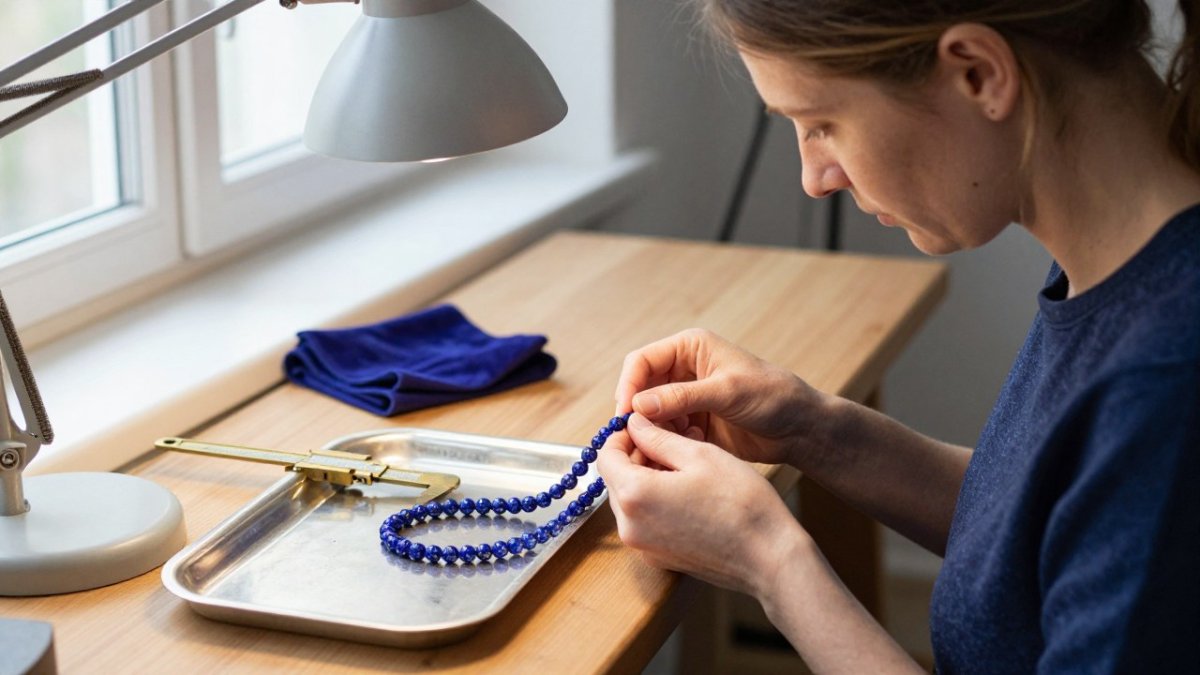
A repeatable checklist beats a seller's label every time. The goal is the same verdict on the same strand on two different days, and equal comparison between two sellers' strands. Set up one controlled inspection station and run every strand through the same steps in the same order.
Set Up a Controlled Viewing Station
Color and clarity judgments are only as good as the light you make them in. Build a station you can return to:
Light: neutral daylight (north-facing window, indirect sun) or a daylight-balanced lamp in the 5000-6500 K range. Avoid warm shop bulbs, which flatter purple, and direct sun, which blows out saturation.
Background: a plain white tray for color and a matte gray or black card for transparency and inclusion checks.
Magnification: a 10x jeweler's loupe is the standard tool, enough for drill holes, surface polish, and inclusions.
Watch out: judging color under a warm bulb and then again under daylight can make the same strand look like two different grades, lock in one light source and use it for every strand you compare.
The Strand-Level Inspection Sequence
Work top to bottom. Do the strand-level checks before you fall in love with individual beads.
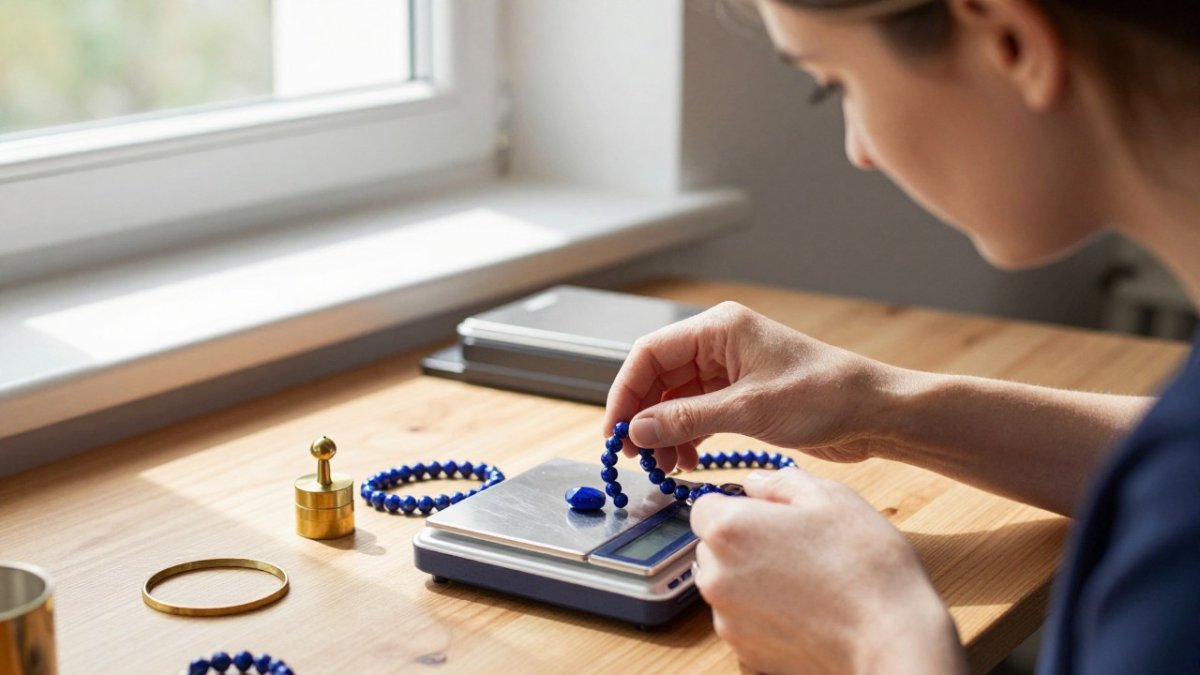
Count and measure first. Count beads against the stated strand count, then caliper a sample of at least ten beads at both ends. A strand sold as 8 mm that ranges from 7.6 mm to 8.4 mm will string unevenly.
Check color consistency across the full strand. Lay it flat and look down its length, not at the top beads. Note hue shifts, saturation drops, and tone jumps. A strand that reads even at arm's length beats one with a few star beads and a weak tail.
Confirm the hue has no brown or bronze cast. Compare against a known-good reference bead if you have one. Brownish tint is the fastest grade-killer in amethyst.
Test transparency bead by bead. Hold each bead against the light; light should pass with a clean glow. Opaque, flat, or cloudy beads are lower grade regardless of the label.
Inspect drill holes under the loupe. Look for chips at the hole edge, off-center drilling, rough interior walls, and burrs. Run a fingernail along each hole, sharp edges fray cord and cut thread.
Check hole diameter against your stringing material. Caliper the hole on a sample. A hole too small for your wire is a return, no matter how good the color.
Look for cracks, pits, flat spots, and polish defects. Tilt each bead under the lamp; pits and dull facets show up as breaks in the reflection.
Run the wax test on a spare bead. Warm water and a soft cloth strip a wax coating; if flaws reappear, the polish was cosmetic.
Photograph the strand in daylight against the white tray for your records, so a reorder can be compared to the original.
Pass/Fail Thresholds That Actually Decide a Return
A checklist is only useful if it tells you when to stop. These are the practical thresholds most makers settle on:
Color: reject if more than a small minority of beads show a brown cast or a visible hue shift from the strand average.
Clarity: reject if cloudy or fractured beads are common enough to break up light along the visible front of a finished piece.
Drill work: reject on any systematic pattern of chipped hole edges or off-center drilling, one bad bead is an outlier, ten is a manufacturing problem.
Two defects matter most. Off-center holes make beads sit crooked on the strand; chipped hole edges fray cord and cut thread. Both are workmanship issues and grounds for a return.
Matching Grade to Your Jewelry Project and Budget
Match the grade to the project, not to your ego. A practice piece doesn't need AAA stones, and a commission piece shouldn't use A grade.
Here's how we'd pair them:
Bracelet making for retail: AA or AAA round beads, 6 mm to 8 mm, matched for color
Necklace making: AA strands where color consistency matters most along the visible front
Earrings: small AAA beads, 4 mm to 6 mm, since the eye gets close
Size and hole diameter drive the rest. A 2 mm bead needs a fine hole and thin cord; an 8 mm or 10 mm bead suits statement bracelets and takes heavier stringing wire.
On price, we won't quote numbers we can't stand behind. Grade, size, cut, and consistency all move the cost, so check current pricing on our product pages.
Choosing Your Next Strand of Amethyst Beads
Grading only pays off when the seller gives you honest information to grade against.
HietalaJewelry provides a curated selection of high-quality, natural gemstone beads in shapes including briolette, rondelle, and marquise.
Start with one strand. Run it through the checklist above.

Ready to put the grading scale to work?
The gap between a strand that sells and one that sits unsold usually comes down to grading discipline.
Frequently Asked Questions
What is the best grade of amethyst for jewelry making?
There is no universal best grade, only the right grade for your design and budget. AAA is the most uniform and saturated, so it suits fine bracelets and necklaces where color consistency across the strand matters. AA works well for everyday pieces where a slight variation reads as natural character. A grade is fine for practice work, samples, and casual designs. Always judge the actual strand in front of you rather than trusting the label alone, because grading scales vary between sellers.
How can you tell whether amethyst beads are natural or lab-grown?
Natural amethyst usually shows subtle internal inclusions, slight color zoning, and small variations bead to bead. Lab-grown quartz tends to look too perfect: even color, no visible inclusions, and identical beads across the strand. Ask the seller directly whether the stones are natural, treated, or synthetic, and get the answer in writing. Under a loupe, look for the tiny irregularities that signal a real stone rather than a manufactured one.
How clear should amethyst beads be for jewelry making?
Clarity needs depend on the look you want. Eye-clean transparency with light, even inclusions grades higher and suits fine jewelry. Heavily included or opaque beads can still be attractive in rustic and bohemian designs, and they usually cost less. What matters most is consistency: a strand where some beads are glass-clear and others are cloudy will look mismatched in a finished piece. Check the whole strand, not just the top bead.
How do I check bead workmanship and drilling before buying?
Inspect the drill holes on several beads from the strand. Holes should sit centered, run straight through, and have smooth edges without chipping or flaking around the opening. Off-center or rough holes cause beads to sit crooked on the wire and can fray cord. Also check for cracks, flat spots, and uneven polish. Ask the seller how they handle defective beads, since a small percentage of flaws is normal in any natural stone batch.

Comments