
7 Trusted Sources to Buy Authentic Lapis Lazuli Beads Online
Last Updated: November 18, 2026
Quick Summary
Buy authentic lapis lazuli beads online from suppliers that state natural or untreated status in writing, list strand length and bead count, and offer a return window. Dedicated gemstone houses like HietalaJewelry, Fire Mountain Gems, and Intrinsic Trading publish these details, while marketplaces often leave them blank.
Real lapis passes four checks: color depth, pyrite pattern, surface texture, and weight.
Calculate cost per bead, not per strand, since a 15-inch strand holds roughly 60 to 65 6mm beads.
Informal grades like AAA, AA, and A are not standardized across sellers, so labels alone tell you little.
Most strands run 15 to 16 inches, though longer 32-inch strands exist for bulk buyers.
Store lapis in a soft pouch away from harder stones and never clean it in an ultrasonic cleaner.
Ready to source real lapis lazuli beads?
HietalaJewelry offers natural gemstone beads in briolette, rondelle, and marquise shapes with free US delivery.
Table of Contents
What Separates Authentic Lapis Lazuli Beads From Cheap Imitations
The single biggest mistake buyers make when they shop to buy authentic lapis lazuli beads online is trusting a product photo instead of a stone. Real lapis has a specific fingerprint: deep blue body color, a scattering of gold pyrite flecks, and a weight that feels denser than dyed quartz or glass. Imitations rarely get all three right at once.
Authentic lapis lazuli is a metamorphic rock, not a single mineral, composed mainly of lazurite along with calcite, pyrite, and other trace minerals. That composition is why genuine stones vary slightly from bead to bead, while cheap imitations look eerily uniform.
The market rewards that uniformity because it's cheap to produce. Dyed howlite, reconstructed stone dust, and glass all photograph beautifully and sell fast. The problem surfaces six months later when the color fades or a client notices the beads aren't what you promised.
Below, we'll show you exactly how to separate the real thing from the fakes before you spend a cent.
How to Tell If Lapis Lazuli Is Real: Four Checks That Work
Real lapis passes four practical checks: color depth, pyrite pattern, surface texture, and weight. If a strand fails two or more, walk away.
Color: Genuine lapis shows a deep, slightly uneven royal or ultramarine blue. Dyed stones look flat and too consistent, and the color often pools in cracks.
Pyrite: Natural gold pyrite flecks are irregular in size and placement. Painted or printed pyrite looks stamped and repeats.
Texture: Real stone feels cool and slightly waxy. Glass feels slick; plastic feels warm.
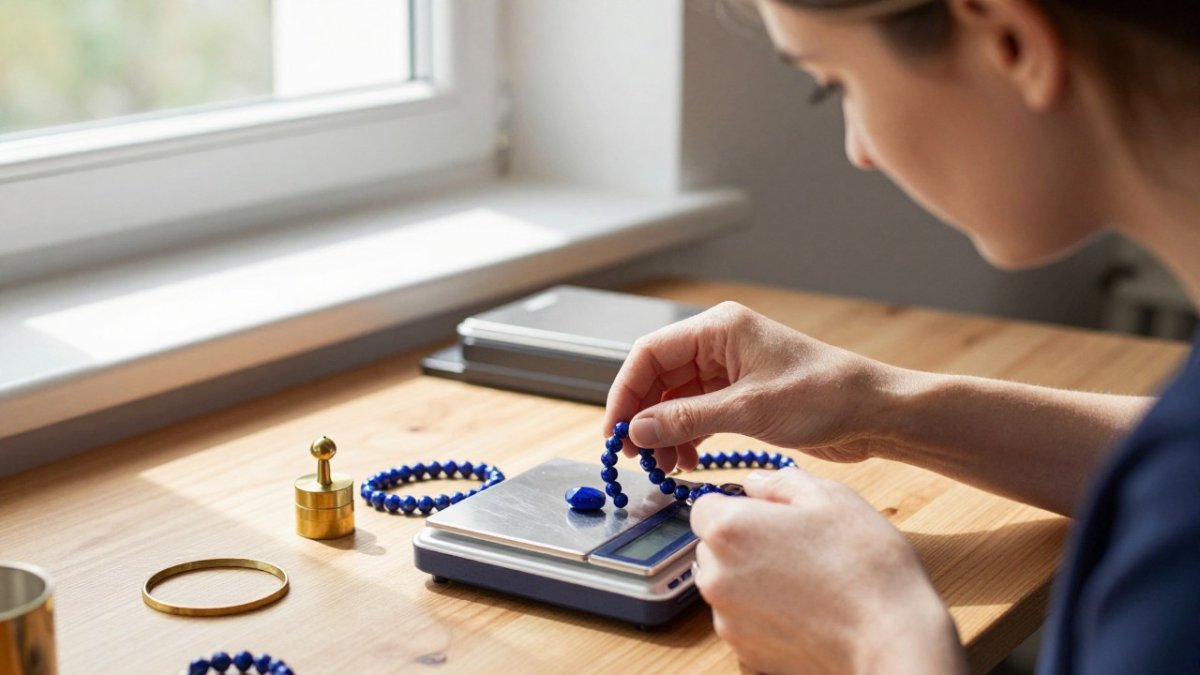
Weight: Lapis is dense. A strand that feels light for its size is usually dyed howlite or reconstituted material.
For a deeper walkthrough of each test, our guide on how to identify natural lapis lazuli breaks the process down bead by bead.

The woman is American.
How to Tell If Lapis Lazuli Is Real Before You Check Out
Most authenticity problems happen at the listing, not the loupe. Before you buy authentic lapis lazuli beads online, check three things on the product page: treatment disclosure, return policy, and seller transparency.
A seller who states "natural, untreated" in writing is accountable for that claim. Wax coating, dyeing, and stabilization are common in the bead trade, and honest suppliers name them.
Ask directly: is the color natural, is the stone dyed, and what is the return window? Reputable sellers answer without hesitation. If a listing is vague about origin or treatment, treat that as a red flag.
Watch out: A "final sale" policy on gemstone beads removes your only real protection. If the stones arrive with cracks or mismatched color, you have no recourse.
Our guide to detecting wax coating on gemstone beads covers the treatment checks that matter most before checkout.
High-Quality Lapis Lazuli Beads: Grading, Treatments, and What to Pay For
High-quality lapis lazuli beads are graded on color saturation, pyrite balance, uniformity, and absence of calcite streaks. The trade uses informal grades like AAA, AA, and A, but those labels are not standardized across sellers, so the label alone tells you very little.
Here is how the grades generally break down:
Grade | Color | Pyrite | Calcite | Typical Use |
AAA | Deep, even royal blue | Sparse, fine flecks | Minimal | Fine jewelry, focal pieces |
AA | Strong blue, slight variation | Moderate flecks | Some visible | Everyday jewelry |
A / denim | Lighter blue | Heavy flecks | Noticeable white | Casual, rustic designs |
Treatments matter as much as grade. Dyeing deepens pale stone, wax coating improves shine, and stabilization fills fractures. None of these are inherently dishonest, but undisclosed treatment is.
Comparing Value Across Bead Size, Strand Length, and Grade
Listings show prices, but they rarely give you a consistent basis for comparing value. The practical method is to calculate cost per bead, not cost per strand. A 15-inch strand of 6mm beads holds roughly 60 to 65 beads, while the same length of 10mm beads holds roughly 38 to 40.
A common pattern is that price per bead rises with grade and size, and falls when treatment is disclosed as dyed or stabilized. When you compare two strands, line up four numbers: strand length, bead size, bead count, and grade. If a seller cannot supply bead count, treat the price as unverifiable.
Watch out: a low price per strand can hide poor matching, cracked beads, or off-size drilling. Factor in the beads you will cull before you decide a strand is cheaper.
For a focused breakdown of how grade, size, and strand length interact, see our natural lapis lazuli beads buying guide.
Lapis Lazuli Bead Shapes and Sizes for Jewelry Making
Lapis lazuli bead shapes and sizes decide how a design reads. Round beads suit classic strands and prayer beads; rondelles sit flat for spacers and stacking; faceted cuts catch light for statement pieces.
Common sizes run from 4mm and 6mm accent beads up to 10mm, 12mm, and 14mm focal beads. Smaller beads suit delicate, repeatable patterns; larger beads anchor a design and cost more per strand.
The woman is American.
Round, Rondelle, and Faceted: Matching Shape to Design
Round beads are the workhorse: smooth, easy to string, and consistent for commercial lines. Rondelles are flattened discs that sit snugly against each other, ideal for spacers and multi-strand work. Faceted beads add sparkle but demand more careful drilling and matching.
If you're comparing shapes for a specific project, our faceted rondelle lapis beads show how a faceted cut changes the look of a strand.
Strand Length and Price Per Strand: Doing the Math
Most strands run 15 to 16 inches, though longer 32-inch strands exist for bulk buyers. To compare value, divide the strand price by the number of beads, not just the length. A cheap strand with poorly matched beads costs more in waste than a slightly pricier, consistent one.
Genuine Lapis Lazuli Bead Suppliers: Seven Options Compared
Genuine lapis lazuli bead suppliers range from dedicated gemstone houses to large marketplaces, and the difference shows up less in the product photo than in what the seller is willing to put in writing. The table below compares seven real options on the factors that actually protect a buyer: treatment disclosure, return policy, strand specification, and available documentation.
Supplier | Starting Price | Sizes / Shapes | Treatment Disclosure | Return Policy | Strand Specification | Documentation | Best For |
HietalaJewelry | Sale pricing, free US delivery | Briolette, rondelle, marquise | States natural, untreated in writing | Standard return window | Strand length and bead count listed | Origin and treatment stated on listing | Makers wanting curated natural stones |
Fire Mountain Gems | $35.94 per strand | Dedicated lapis collection | Treatment noted on product pages | Standard return policy | Strand length and size listed | Product-level descriptions | Browsing a full gemstone catalog |
Intrinsic Trading | $28.99 sale / $57.98 regular | 4mm, 6mm, 8mm, 10mm round | Treatment noted where applicable | Standard return policy | 15.5-inch strands, bead count listed | Product-level descriptions | Wholesale round beads |
Gem Wholesales | $11 | 6mm, 8mm, 10mm; 15.5-inch strand | Limited disclosure | Standard return policy | 15.5-inch strand | Minimal | Budget wholesale round beads |
Beads of Cambay | Not listed | 2mm-14mm, round/rondelle/tube | Ask before ordering | Ask before ordering | Varies by listing | Minimal | Range of shapes and sizes |
Tejas Beads | Not listed | Strand-sold, pyrite-flecked | Explains dyed-lapis terminology | Ask before ordering | Strand-sold | Educational content on treatments | Buyers wanting dyed-lapis education |
Etsy / Amazon marketplaces | Varies by listing | Mixed, incl. chip beads | Varies by seller; often silent | Varies by seller; some final sale | Varies by listing | Rarely provided | Comparing individual listings |
A common pattern is that dedicated gemstone suppliers publish treatment and strand details, while marketplaces leave those fields blank or inconsistent.
Watch out: a listing that shows a beautiful strand but never states bead count, strand length, or treatment status is asking you to buy on faith. Ask the seller directly, in writing, before you check out.
When comparing suppliers, score each one on four questions: Does the listing state natural or treated? Does it give strand length and bead count? Is there a return window? Is origin disclosed? A supplier that answers all four is easier to hold accountable than one that simply has the lowest price per strand.
Care, Durability, and Storage for Lapis Beads
Lapis is softer than quartz, so it scratches and chips more easily than harder stones. Keep beads away from household cleaners, perfume, and prolonged sunlight, which can fade dyed color.
Store strands in a soft pouch or lined box, separated from harder stones. Clean with a damp cloth only, never an ultrasonic cleaner, which can loosen wax coatings or fracture inclusions.
Order Your First Strand From HietalaJewelry
The challenge with buying lapis online is trust: you can't hold the stone before it ships. HietalaJewelry offers a curated selection of natural gemstone beads in shapes like briolette, rondelle, and marquise, with sale pricing and free delivery within the USA.
When you're ready to buy authentic lapis lazuli beads online, start with a strand you can inspect, then scale to consistent reorders. Browse our AAA natural lapis lazuli bead strand to see the quality for yourself.
Get started with HietalaJewelry and source natural stones that hold their color and their value.
Real lapis rewards buyers who check the stone, not just the photo. Start with one strand, run the four checks, and let the quality speak for itself.
Frequently Asked Questions
How can you tell if lapis lazuli beads are real or fake?
Look for natural variation: real lapis lazuli beads show a deep blue base with gold pyrite flecks and occasional white calcite patches, and no two beads match exactly. Dyed stones often have color pooled in cracks, and imitation beads made from glass or resin look uniformly blue with no pyrite depth. Check the drill holes for dye residue, ask the seller for treatment disclosure, and request close-up photos of the actual strand you will receive. A price far below the rest of the market is another warning sign.
How much do authentic lapis lazuli beads cost?
Pricing depends on bead size, strand length, shape, and grade, so there is no single figure. Smaller round beads on shorter strands cost less than large faceted or rondelle cuts in the top grades. When you compare listings, calculate price per bead or price per inch of strand rather than comparing headline prices, since a 15-inch strand and a 32-inch strand are not the same purchase. Check HietalaJewelry's site for current sale pricing and free delivery terms.
Are lapis lazuli beads sometimes dyed or treated?
Yes. Dyeing is common in lower-grade lapis, and some beads are stabilized or coated to deepen the blue and hide white calcite. Reputable suppliers state treatments clearly in the listing. Natural, untreated lapis with strong royal blue color and even pyrite distribution commands a higher price, so a seller offering vivid blue at a bargain rate without mentioning treatment is worth questioning. Ask directly before you buy.
Which lapis lazuli bead shapes work best for jewelry making?
Round beads in 4mm to 8mm sizes suit bracelets, necklaces, and spacer work. Rondelle cuts sit well in stacked bracelets and accent rows. Faceted and briolette shapes catch light for earrings and focal pieces, while chip beads and irregular shapes fit rustic and prayer bead designs. Match the shape to the piece: uniform round beads for repeatable commercial lines, and mixed or faceted shapes for one-off designs.

Comments