
Gemstone Bead Manufacturing Standards: 2026 Guide
Table of Contents
What High Quality Gemstone Bead Manufacturing Standards Actually Mean
Material Grading: What AAA, AA, and A Really Tell You
Natural vs Lab Grown Gemstone Market Trends in 2026
Cutting, Polishing, and Drilling: Where Quality Is Won or Lost
Common Gemstone Treatments and Enhancements to Watch For
How to Identify Authentic Gemstone Beads Before You Buy
Choosing a Wholesale Supplier: Verification and Quality Control
Frequently Asked Questions
Last Updated: September 27, 2026
What High Quality Gemstone Bead Manufacturing Standards Actually Mean
High quality gemstone bead standards are the objective, measurable benchmarks that separate a strand worth stringing from a bag of rejects: color consistency, calibrated sizing, burr-free drilling, and verified provenance. This guide from HietalaJewelry breaks down how those standards work in practice, so you can judge a supplier on evidence rather than adjectives.
Most buying advice says to look for "premium" or "AAA" without explaining what those words certify. They certify nothing on their own, a grade is only meaningful when tied to a defined inspection process.
Beads fail in predictable ways: color that drifts across a strand, holes that chip during stringing, dimensions that shift between reorders. Each failure traces back to a specific manufacturing stage, so here's what to inspect before you commit to a commercial line.
Material Grading: What AAA, AA, and A Really Tell You
The AAA, AA, and A system is a visual grading convention, not a universal standard. No single body enforces it, so one supplier's AAA can match another's AA. Treat the label as a starting point for questions, never a guarantee.
A grade is only as good as the inspection process behind it, which has four measurable components: sample size, lighting conditions, measurement tools, and rejection criteria. Ask a supplier to describe all four and you'll learn more in five minutes than a catalog page tells you in five paragraphs.
Sample size. A defensible inspection pulls a defined percentage of beads from each lot, commonly every bead on a sample strand plus a random selection from each batch. A supplier who "checks quality" without stating how many beads they look at is grading decoratively.
Lighting conditions. Color grading is meaningless under inconsistent light. Professional graders work under daylight-balanced lamps rated around 5000-6500K, because incandescent and cool-white office lighting both shift how a stone reads.
Measurement tools. Calibrated sizing is verified with a digital caliper or go/no-go gauge, not by eye. Diameter tolerance is typically stated in millimeters, for example, ±0.2 mm on a 6 mm round, and a supplier who can't state a tolerance is not calibrating. Hole diameter matters too: a 0.8 mm spec that drifts to 1.0 mm lets beads wobble on the string.
Rejection criteria. A grade is defined as much by what gets pulled as by what ships. Ask what fraction of a batch is rejected and why. A supplier rejecting under 1% of a natural-stone lot is either sourcing extraordinary rough or not looking closely.
The visual criteria break down as follows.
Color consistency comes first. In a well-graded strand, adjacent beads sit within a narrow tonal range with no outliers. Lay the strand flat under neutral light and scan for any bead that breaks the run.
Clarity grading comes next. Natural stone carries inclusions; the question is whether they're evenly distributed and whether any bead has a fracture that threatens stringing durability. A fracture reaching the drill hole is a structural defect, not a cosmetic one.
Surface finish rounds out the assessment. A polished finish should be uniform, with no dull patches, pits, or grinding marks. Tilt each bead under the light; a true polish reflects cleanly across the whole surface.
Grade | Color Match | Clarity | Surface | Typical Use |
AAA | Tight, near-identical | Minimal, even inclusions | Mirror polish, no pits | Fine jewelry, retail lines |
AA | Close, minor variation | Visible but stable inclusions | Good polish, minor flaws | Mid-tier commercial work |
A | Noticeable variation | Prominent inclusions | Acceptable, some dull spots | Craft, practice, budget pieces |
A common mistake is buying grade on price alone. Ask instead for the supplier's inspection criteria: how many beads per strand are sampled, what diameter tolerance is allowed, what light the grade was assigned under, and whether rejects are pulled by hand or machine. A supplier who can answer is grading; one who can't is labeling.
Pro Tip When you receive a sample, re-grade it yourself against the supplier's stated criteria. Measure ten random beads with a caliper, check color under a daylight-balanced lamp, and inspect hole edges with a loupe. If your numbers match the spec, the supplier's process is real. If they don't, you've saved yourself a bulk order.
Natural vs Lab Grown Gemstone Market Trends in 2026
Natural vs lab grown gemstone market trends in 2026 point in one direction: buyers want transparency about which is which, and they're rewarding sellers who state it plainly. Lab grown stones are chemically identical to natural ones, but their value proposition differs.
Natural stone commands a premium because no two beads are identical and supply is finite. Lab grown material offers consistency and predictable pricing, suiting production lines that need thousands of matching units.
What's shifted is disclosure. Buyers burned by mislabeled imports now ask for gemstone identification documentation up front, and suppliers who can't provide it lose the order.
Watch Out The most common sourcing failure is ordering "natural" stone and receiving treated or synthetic material with no paperwork. Once beads are strung and sold, you carry the reputational cost, not the supplier. Always get material origin in writing before payment.
Cutting, Polishing, and Drilling: Where Quality Is Won or Lost
Cutting, polishing, and drilling decide whether a bead survives its first year of wear. This is where cheap manufacturing shows, and the stage buyers inspect least.
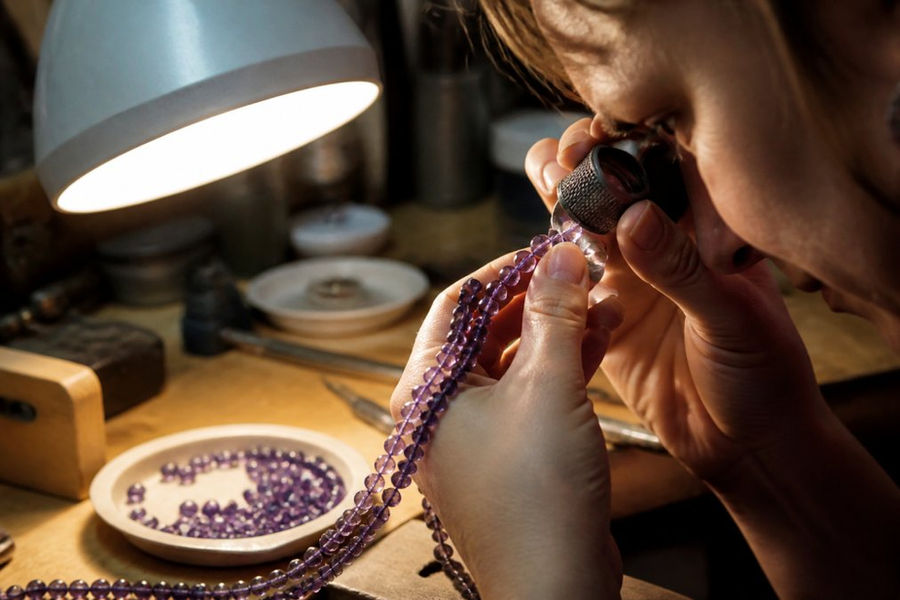
Pro Tip Inspect hole quality under magnification before you string anything. A loupe costs little and catches chips, cracks, and off-center drilling that you'd otherwise discover after a client complaint. Pair it with a digital caliper for diameter and you've covered the two checks that catch most defects. It's the single fastest quality screen you can run.
Watch Out Don't run scratch or acid tests on finished strands you intend to sell. Hardness picks and RI testing belong on loose rough or on a sacrificial sample, not on inventory. If you need material confirmation, request a lab report from the supplier rather than testing the beads yourself.
Common Gemstone Treatments and Enhancements to Watch For
Common gemstone treatments and enhancements are routine in the trade, and most are legitimate when disclosed. The problem isn't treatment; it's silence about it.
How to Identify Authentic Gemstone Beads Before You Buy
How to identify authentic gemstone beads comes down to three checks: visual inspection, physical testing, and documentation. No single method is conclusive alone, so run all three.
Check | What to Look For | Red Flag |
Visual | Irregular inclusions, tonal variation | Uniform color across large batches |
Physical | Cool touch, hardness match | Warms instantly, scratches easily |
Documentation | Written origin, treatment disclosure | No paperwork, vague answers |
Choosing a Wholesale Supplier: Verification and Quality Control
Key Takeaway Judge a supplier on three things: documented sourcing, stated dimensional tolerances, and a sample you've measured yourself. Everything else is marketing.
HietalaJewelry stocks natural gemstone beads in briolette, rondelle, and marquise cuts, with free delivery on orders within the USA and sale pricing that keeps premium material accessible for both hobbyists and commercial makers. If you need consistent calibrated sizing for a product line, that's the conversation to have before your first bulk order.
Frequently Asked Questions
What is AAA gemstone grade, and does it guarantee quality?
AAA is a trade shorthand, not a universal standard. It typically signals the top band a supplier carries: even color, few visible inclusions, and consistent cut. Because no single body enforces AAA across the industry, two sellers can label very different beads AAA. Use the grade as a starting point, then verify with your own inspection of color consistency, clarity, surface polish, and drill quality before committing to a bulk order.
How can I tell if gemstone beads are real or fake?
Start with the basics: natural stone shows slight variation in color and pattern from bead to bead, while glass or dyed imitations look uniform. Check for bubbles (a glass sign), look at drill holes for smooth burr-free edges, and test hardness against the Mohs scale, since quartz-family stones scratch glass and most fakes do not. For higher-value stones, ask the supplier for gemstone certification or third-party identification before you buy in bulk.
What manufacturing defects should I look for in gemstone beads?
Inspect each strand for cracked or chipped beads, off-center or rough drill holes, uneven sizing within a strand, and color that shifts noticeably from bead to bead. Burr-free drilling matters most for stringing durability, since rough edges fray cord and wire. Ask your supplier what percentage of defect is acceptable, and confirm their quality inspection process covers drilling precision, calibrated sizing, and strand uniformity before shipment.
How do gemstone treatments and enhancements affect bead value?
Treatments like heating, dyeing, fracture filling, and irradiation are common and often permanent, but they change how you should price and describe a stone. Heat treatment on amethyst or sapphire is widely accepted; dyeing and fracture filling are not, and they can fade or fail over time. Ask suppliers to disclose every treatment up front. Undisclosed enhancement is the fastest way to lose customer trust on a commercial jewelry line.
What should I check before choosing a wholesale gemstone bead supplier?
Ask for their quality control process, defect rate, and whether they offer gemstone certification on request. Request sample strands in the exact shapes and sizes you plan to reorder, such as rondelle or briolette cuts, and confirm they can hold calibrated sizing run to run. Check return policy, order minimums, and delivery timelines against your production schedule. A supplier who answers these directly is usually a safer long-term partner than one who only quotes price.
What are the current natural vs lab grown gemstone market trends?
Lab grown stones have gained share in the fine jewelry market because they offer identical optical and physical properties at lower cost, and buyers increasingly accept them when disclosed. Natural stone demand remains strong in artisan and heirloom-style work, where inclusions and slight color variation are seen as character. For bead buyers, the practical takeaway is disclosure: label natural and lab grown clearly, and price each according to what it actually is.
Read more


Comments