
9 Best Crystals for Meditation Practice
Table of Contents
1. How to Meditate With Crystals: The Basics
Setting an Intention and Holding a Stone
Where to Place a Crystal During Practice
2. Amethyst for Meditation: The Calm and Clarity Standby
3. Clear Quartz: The Amplifier for Any Intention
4. Rose Quartz: Heart-Centered Emotional Balance
5. Black Tourmaline and Hematite: Grounding and Protection
6. Moonstone, Selenite, and Sodalite: Third Eye and Crown Work
Sodalite: Third Eye Focus
Selenite: Crown Placement
Moonstone: The In-Between Stone
How to Choose Between Them
7. Crystals for Meditation and Focus: A Beginner Routine
8. Meditation Crystals for Beginners: Care, Cleansing, and Safety
Cleansing Without Damaging the Stone
Storage That Prevents Damage
Safety Around Handling
Buying: Size, Comfort, and Sourcing
Practicing Without Buying Anything
Frequently Asked Questions
Last Updated: October 6, 2026
1. How to Meditate With Crystals: The Basics
The 9 best crystals for meditation practice work the same way a good soundtrack does: they set a tone, then get out of the way. You hold a stone, set an intention, and let the object anchor your attention.
Meditation with crystals is the practice of holding or placing a gemstone during quiet sitting to support focus and intention. The stone serves as a physical cue, much like a breath count.
Setting an Intention and Holding a Stone
Start with one word. "Calm." "Focus." "Rest." Hold your stone in your non-dominant hand and let it warm up. A common mistake is grabbing a stone and expecting it to do the work. The intention does the work. The stone reminds you of it.
Where to Place a Crystal During Practice
In your palm: best for grounding stones like Black Tourmaline
On your forehead: traditional for Third Eye work with Sodalite or Fluorite
Above your head: Crown Chakra placement for Selenite or Apophyllite
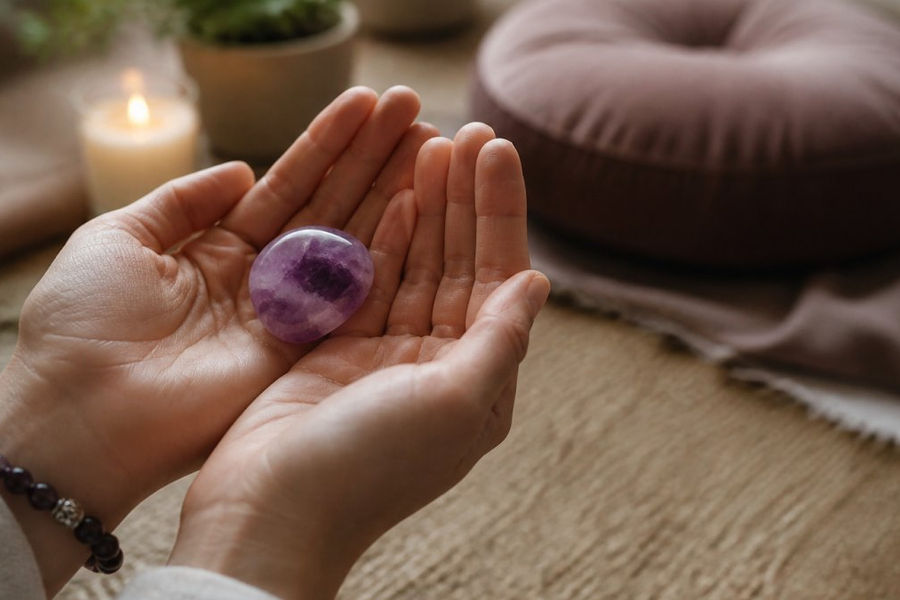
A quick word on honesty: crystal meditation is a mindfulness aid, not medical treatment. The National Center for Complementary and Integrative Health overview of complementary health approaches is clear that gemstones have no proven clinical effect on disease.
2. Amethyst for Meditation: The Calm and Clarity Standby
Amethyst is the most popular meditation stone for one practical reason: it's easy to find, easy to hold, and its purple color is genuinely soothing to look at. In traditional crystal lore, amethyst for meditation is linked to calm, clarity, and the Crown Chakra.
Why it works as a practice tool:
Smooth tumbled pieces sit comfortably in the hand
The color gives your eyes a restful focal point
It pairs with any intention, from sleep to study
If you're buying a piece, look for even color and no visible cracks.
3. Clear Quartz: The Amplifier for Any Intention
Clear Quartz is the blank canvas of the crystal world. Traditional sources call it an amplifier, meaning it's said to strengthen whatever intention you bring to it. That makes it the safest first stone for beginners who haven't picked a goal yet.
Ethan Lazzerini
Hold it and repeat your intention three times. That's it. The stone's clarity gives your mind something clean to rest on.
4. Rose Quartz: Heart-Centered Emotional Balance
Rose Quartz is the stone most associated with the heart, and that's where it belongs during practice. Place it flat against your chest and breathe slowly for five minutes. Traditional practice links it to emotional balance and self-compassion.
Many people find this the easiest stone to sit with. The pink is warm, the surface is usually smooth, and the placement gives your hands something to do besides fidget.
5. Black Tourmaline and Hematite: Grounding and Protection
These two stones handle the practical end of meditation: staying rooted. Black Tourmaline is the traditional choice for protection and clearing negative energy. Hematite is heavier and denser, and many practitioners use it for grounding.
Stone | Traditional Use | Best Placement | Feel |
Black Tourmaline | Protection, clearing | Palm or beside you | Light, slightly rough |
Hematite | Grounding, stability | Palm, both hands | Heavy, metallic sheen |
If your mind races during sitting, start here. The weight of Hematite gives your hands a job.
6. Moonstone, Selenite, and Sodalite: Third Eye and Crown Work
Upper-chakra stones get recommended constantly, but most lists skip the part that actually matters: what "Third Eye work" and "Crown work" mean in practice, and why the placement changes the experience. Here's the short version before the stone-by-stone breakdown.
In traditional chakra frameworks, the Third Eye (Ajna) sits between the eyebrows and is associated with focus, insight, and clear seeing.
Sodalite: Third Eye Focus
Sodalite is the deep-blue stone most often used for Third Eye placement. It's a feldspathoid mineral, usually mottled blue with white calcite veining, and it's inexpensive enough that beginners can try it without committing. Traditional practice links it to clear thinking and mental focus.
Placement: Rest it lightly on the forehead between the brows while lying down, or hold it in your palm and direct attention to that point.
Best for: Racing thoughts, study sessions, decision-making.
Practical note: Sodalite is relatively hard (roughly 5.5-6 on the Mohs scale) and tolerates brief water rinses, but the white veining can look dull if you scrub it.
Selenite: Crown Placement
Selenite is a variety of gypsum, which matters for care: gypsum is soft (about 2 on the Mohs scale) and water-soluble, so it should never be rinsed or soaked. Traditional sources associate it with the Crown Chakra and with clearing or resetting a space.
Placement: Above the head, on a shelf nearby, or held loosely at the crown. Many practitioners use a selenite wand to sweep the space around them before sitting.
Best for: Wind-down practice, spacious or "quiet mind" sits, room clearing.
Practical note: Store it dry, away from humid bathrooms, and handle it gently, it scratches and flakes easily.
Moonstone: The In-Between Stone
Moonstone is a feldspar with a characteristic adularescence, that soft, floating sheen that shifts as you tilt it. Traditional practice links it to intuition, emotional cycles, and inner peace, which places it between the Third Eye and the heart rather than squarely in either chakra.
Placement: Palm or heart works well; some practitioners rest it at the brow for intuition-focused sits.
Best for: Emotional reflection, journaling before or after meditation, transitional life phases.
Practical note: Moonstone is moderately soft (about 6 on the Mohs scale) with cleavage planes, so it chips if dropped. Keep it in a pouch.
How to Choose Between Them
If your goal is... | Start with... | Placement |
Sharper focus, mental clarity | Sodalite | Forehead or palm |
Spacious, quiet, wind-down sits | Selenite | Above the head or nearby |
Intuition, emotional reflection | Moonstone | Palm or heart |
A common mistake is stacking all three at once, forehead, crown, and palm, and then wondering why the sit felt cluttered. Pick one, sit with it for a week, and note what changes. If nothing does, that's useful information too; the stone is a cue, not a cause.
Pro Tip If you're lying down for forehead placement, use a stone with a flat, polished face. Rough or pointed pieces are uncomfortable against the brow and easy to knock loose.
7. Crystals for Meditation and Focus: A Beginner Routine
Here's a 10-minute routine you can run tonight. It uses one stone, so you don't need a collection to start.
Pick your stone. Match it to your goal: Amethyst for calm, Clear Quartz for focus, Hematite for grounding.
Sit comfortably. A cushion, a chair, or the floor. Cross-legged is fine, but not required.
Set your intention. Say it out loud once. One word or one short phrase.
Hold or place the stone. Palm, heart, or forehead, depending on the stone.
Breathe for five minutes. In through the nose, out through the mouth. Feel the stone's weight and temperature.
Notice without judging. When your mind wanders, return to the stone's texture.
Close slowly. Set the stone down, take three slow breaths, and open your eyes.
Pro Tip If your hands get sweaty, the stone will slip. A small square of cloth under your palm fixes it, and it also keeps body oils off polished surfaces.
8. Meditation Crystals for Beginners: Care, Cleansing, and Safety
Most crystal lists stop at properties and never tell you how to keep the stone in usable condition or how to buy one responsibly. That's the part that actually determines whether you'll still be using it six months from now. Here's the practical version.
Cleansing Without Damaging the Stone
"Cleansing" is a traditional practice, not a chemical process, so the goal is simple: reset the stone as a ritual object without harming the material. The method matters more than the ritual.
Lukewarm water rinse: Safe for harder stones like clear quartz, amethyst, rose quartz, and hematite (pat hematite dry immediately, it can rust).
Skip water entirely for: Selenite and other gypsum varieties (water-soluble), halite/salt stones (they dissolve), malachite and azurite (some copper minerals are damaged by water), and any stone with visible fractures.
Skip salt for: Anything soft, porous, or layered. Salt is abrasive and can scratch polished surfaces or work into cracks.
Storage That Prevents Damage
Hardness is the number to know. On the Mohs scale, quartz-family stones sit around 7, while selenite is about 2 and moonstone about 6. Storing a 7 against a 2 in the same pouch means the harder stone will scratch the softer one.
Keep each stone in its own soft pouch or a compartmented tray.
Store selenite, moonstone, and fluorite separately from quartz, hematite, and anything with a rough surface.
Keep stones out of direct sun and away from radiators or windowsills that swing in temperature.
Safety Around Handling
Check edges before long sits. A chipped or rough edge will wear on your palm over a 10-minute session. Run a thumb along the edge first.
Never put a crystal in your mouth or use it to make "crystal water." Some minerals contain trace metals, and the U.S. Food and Drug Administration guidance on gemstone and mineral safety in consumer products treats mineral composition as a real safety question rather than a folk remedy.
Keep small tumbled pieces away from children and pets. Choking risk is the obvious concern; the less obvious one is that pets chew.
Watch Out Crystals are not a substitute for medical care. If you're dealing with anxiety, depression, or a health condition, talk to a licensed professional. The Substance Abuse and Mental Health Services Administration treatment locator can point you to real help.
Buying: Size, Comfort, and Sourcing
A few practical considerations that most guides skip:
Size: For palm-holding, roughly 1 to 1.5 inches across is the sweet spot. Bigger stones get heavy over a 10-minute sit; smaller ones are easy to lose grip on.
Finish: Tumbled (smooth, rounded) is the most comfortable for hand-holding. Raw or pointed pieces work better for placement on a shelf or above the head.
Authenticity: Dyed, heat-treated, and glass-imitation stones are common in the market. If a stone's color looks unnaturally uniform or the price is far below typical for that material, treat the identification as uncertain. For meditation use, that's usually fine, the stone still works as a tactile cue, but don't pay a premium for a stone you can't verify.
Practicing Without Buying Anything
The practice doesn't require a purchase. If you don't have a crystal, or you're not ready to buy one, any small familiar object works the same way: a smooth river stone, a coin, a ring, a shell. The mechanism is identical, a physical anchor for attention. You can also visualize a stone in your palm and hold your attention there.
Key Takeaway Care comes down to three rules: match the cleansing method to the stone's hardness and solubility, store soft stones away from hard ones, and treat any crystal as a mindfulness tool rather than a health product.
Frequently Asked Questions
What crystal is best to meditate with?
There is no single best crystal for meditation because the right choice depends on your goal. Amethyst is a popular pick for calm and clarity, Clear Quartz for amplifying an intention, and Black Tourmaline for grounding. If you are new, start with one stone and use it consistently for a week so you can notice how it fits your practice rather than switching daily.
How do you use crystals during meditation?
Hold a stone in your palm, place it on your lap, or set it on a surface within reach. Many people hold the crystal in their non-dominant hand and rest the dominant hand over it. Before you begin, set a clear intention for the session, then let the stone sit as a physical anchor for your attention. If your mind wanders, return your focus to the weight and temperature of the crystal.
Can beginners meditate with crystals?
Yes, beginners can use meditation crystals without prior experience. Start with a five-minute session, one stone, and a simple goal like calm or focus. Sit comfortably, hold the crystal, and follow your breath. The stone acts as a tactile reminder to stay present. There is no special skill required, and you can build session length as the habit settles.
How do you choose a crystal for meditation?
Choose by goal first: calm and stress relief, focus and concentration, grounding and protection, or spiritual awareness. Then match the stone to that goal, such as Amethyst for calm, Fluorite for focus, or Hematite for grounding. Hold a few options and notice which one you naturally reach for. Practical factors like size, smooth edges, and how it feels in your hand matter as much as tradition.
Read more
Comments